Why AI Adoption in Life Sciences Fails to Transform Workflows
Handing AI tools to individuals improves discrete tasks. The throughput leaders actually want changes only when the operating model around departmental and governance workflows moves with the technology.
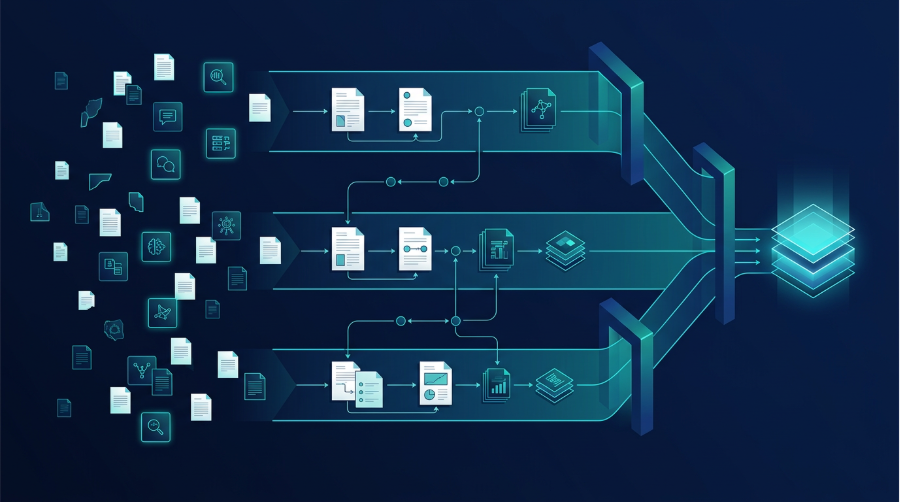
There is a pattern across large life sciences organizations right now where AI tools get licensed and handed to individual contributors, with the expectation that meaningful change will follow.
Several quarters in, scientists, analysts, and physicians are faster on specific micro-processes, yet the workflows the company actually runs, the ones that produce a target safety assessment, an integrated development plan, or a candidate selection recommendation, look much like they did before.
I want to name that gap directly because distributing AI to individuals reliably improves how people perform discrete tasks, but workflow transformation does not follow from micro-productivity rolling up on its own.
It follows from changing the operating model around those workflows at the same time as the technology, with corresponding changes to incentives, timeline expectations, review standards, explicit work products, and governance. When AI is treated as a “deployment exercise” rather than an operating-model change, the gap persists.
Three levels of workflow
It helps to be precise about what the word workflow is doing, because executives, IT, and individual scientists often mean different things by it.
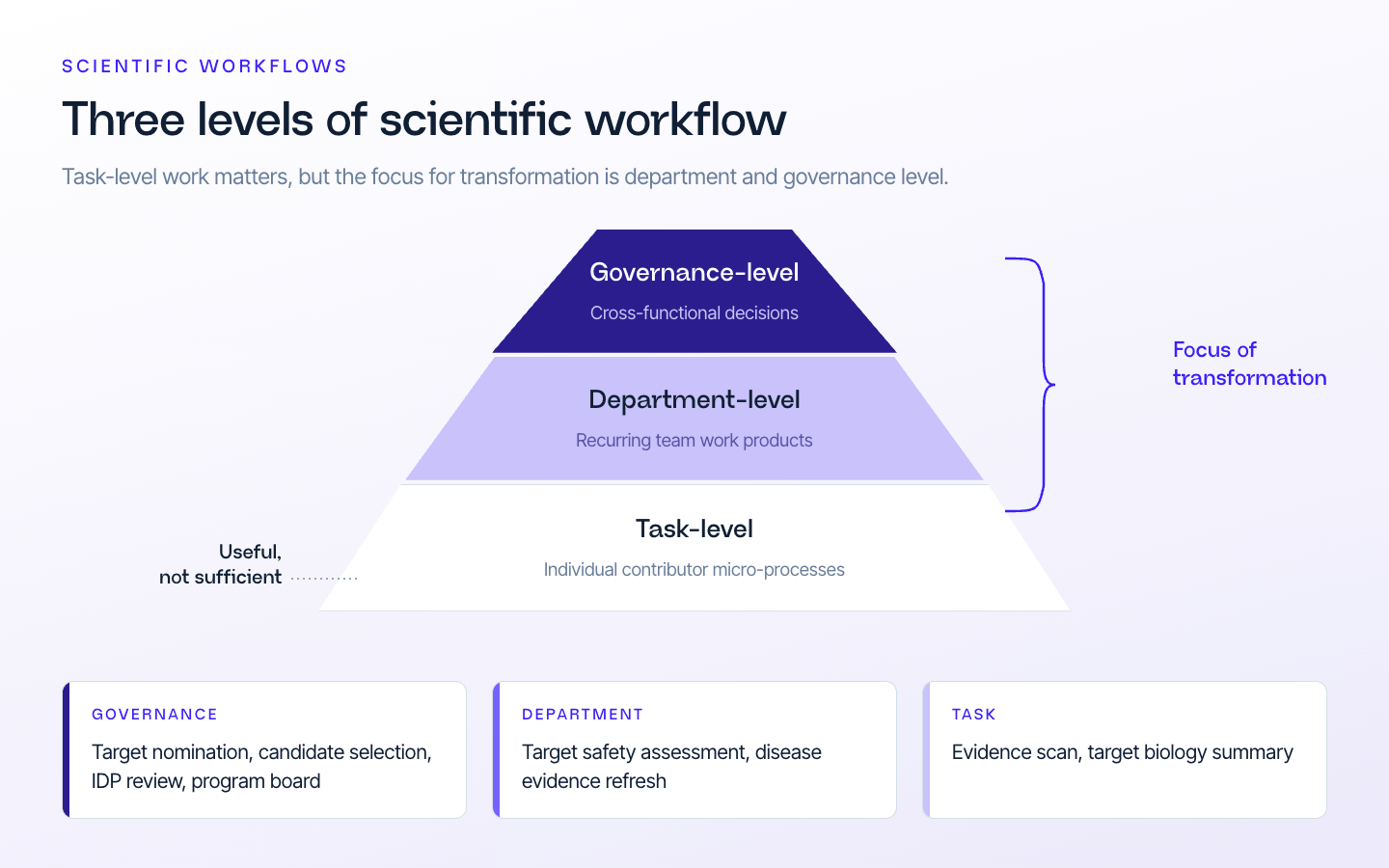
The first level is task-level workflows for individual contributors, where the work largely involves summarizing papers, drafting report sections, screening lists, and querying databases. These are useful and worth accelerating, but they are not where the strategic value sits, and not the focus here.
The second level is department-level workflows. A safety department produces a target safety assessment as a recurring work product. A clinical development team produces a protocol synopsis or an evidence summary for a study question. These are the deliverables a department is accountable for, and they are usually what senior leaders mean when they talk about productivity in R&D.
The third level is governance-level workflows, which center on formal decision forums including target nomination, candidate selection, integrated development plan review, and discovery and clinical program board reviews. The work product here is a decision, supported by an evidence package that must meet specific standards for downstream review and reuse.
Task-level acceleration becomes department-level or governance-level value only when the operating model around those workflows moves with it. The figure below sets out the three levels and where the work of transformation sits.
Why micro-process speed does not roll up on its own
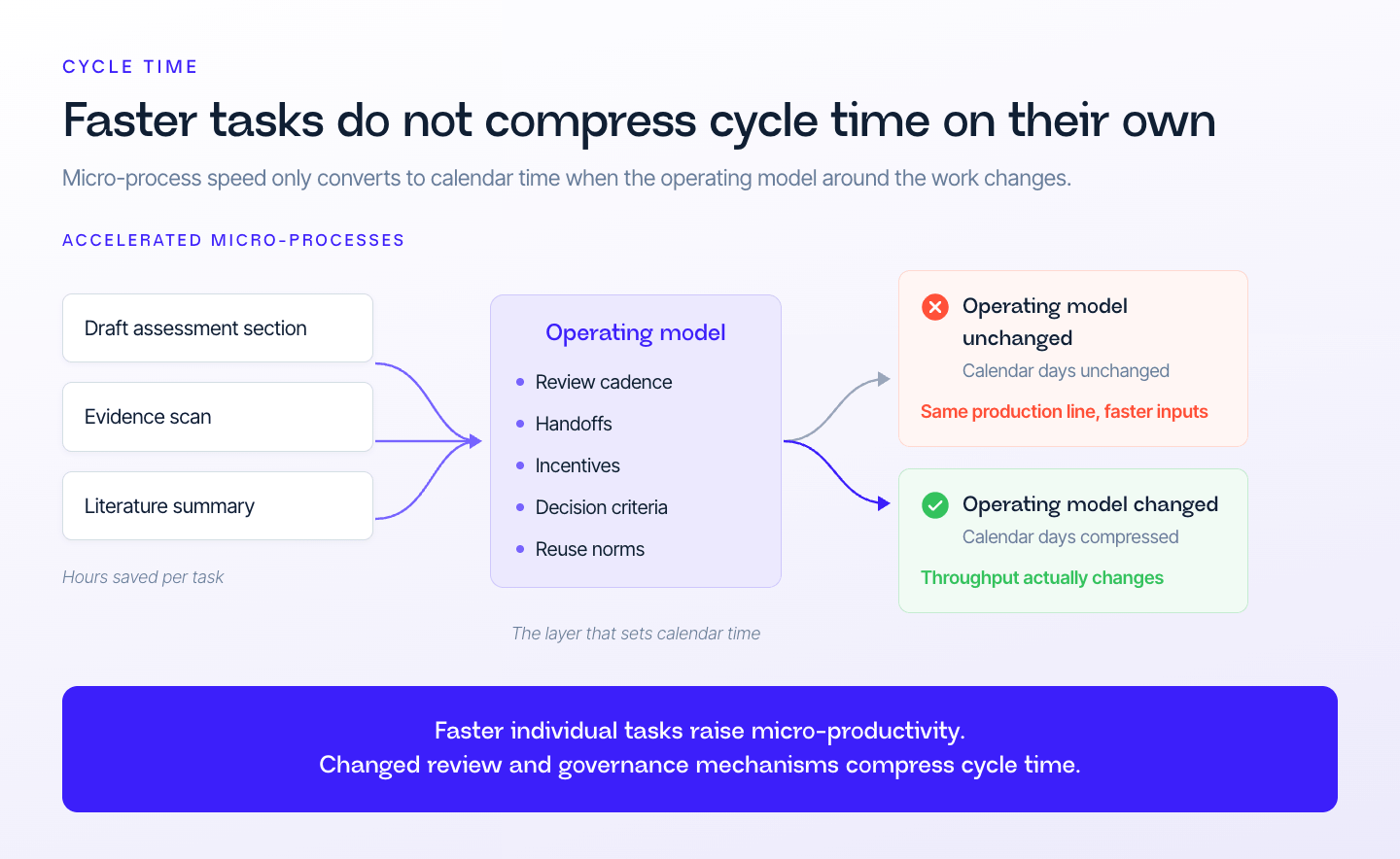
Consider a senior toxicologist who now drafts a section of a target safety assessment in two hours instead of two days. The finished assessment does not appear two days earlier. It is still produced on the same cadence, reviewed by the same committee, against the same checklist, so the time saved upstream is absorbed by the process around it.
For workflow-level throughput to materialize, several things have to move together:
- Incentives need to reward faster, higher-quality deliverables rather than effort hours.
- Timeline expectations for recurring work products need to compress.
- Review standards for AI-supported outputs need to be defined, including how evidence is checked and what reviewers are accountable for.
- The work products themselves need explicit definitions, so the team and the AI agree on what is being produced and to what standard.
- Evidence and reuse norms need to be set, so an assessment produced for one target can inform the next.
Without those changes, an organization ends up with faster individual outputs and an unchanged production line. The figure below shows where micro-process speed is absorbed and what has to change for cycle time to compress.
The software engineering analogy
There is a comparison that comes up whenever this topic does, involving AI-generated code in software engineering. It is a useful analogy when handled precisely. Coding agents did not, on their own, change engineering throughput in the teams that adopted them.
The teams that saw real change adapted their review practices to the volume and style of AI-produced code, updated testing and integration pipelines, and rethought ownership so that a human engineer carried accountability for the resulting system. The model produced more code, and the operating model around code production absorbed and shaped it.
Scientific deliverables need an analogous shift, with standards that fit biomedical R&D. A target safety assessment drafted with AI support becomes a real work product once the department has agreed on how it will be reviewed, what evidence and provenance standards apply, who signs off, and how the artifact is reused in the next program.
Review here must account for evidence quality, provenance back to the underlying literature and data, and the scientific judgment that no automated test can substitute for. That is why enterprise AI in life sciences needs more than coding agents, with the difference sitting in verification.
What this means for CIOs and business leaders
For CIOs, R&D IT leaders, and the business leaders they partner with, the practical implication is that AI strategy has to be tied to specific department-level and governance-level workflows, not only to seat deployment or prompt usage. That changes the questions worth asking: Which departmental work products do we want to transform this year, and at what cycle time and evidence standard? Which governance forums depend on those work products, and how will review change when the upstream artifact is AI-supported?
This is also where codifying a department's expert process matters. When a recurring deliverable is encoded as a governed, repeatable workflow, it becomes a form of organizational memory rather than something that lives in a few experts' heads, and the output can be held to a decision-ready standard. Seat counts and prompt volumes measure access rather than transformation, and they should not stand in for workflow-level change.
Where Causaly fits
We work with R&D organizations trying to make this shift, particularly in target assessment, safety, translational, and clinical evidence workflows.
Our technology is built for the evidence and reasoning demands of those workflows, and the more useful part of most engagements is the combination of two things: an understanding of the scientific workflow technology itself, and an understanding of how enterprise R&D operating structures actually function, including how a safety department restructures around AI-supported assessments and how a governance board adjusts its review standards.
The technology matters. The operating model around it matters as much, and it is where most of the distance between expectation and outcome currently sits. Leaders who treat AI in R&D as a workflow and governance question, and not only a tools question, are the ones who will see the throughput change they expected.
Further reading

.png)
.png)
.png)

Get started with Causaly
Ready to transform the way your R&D teams discover and deliver? Take the first step - see Causaly for yourself.
Request a demo