Leveraging AI for Target Product Profiles to Improve Portfolio Decisions
Building one defensible TPP is expensive enough that most assets get only one, scoped to whichever indication the team picked first, even when the biology could support many more.
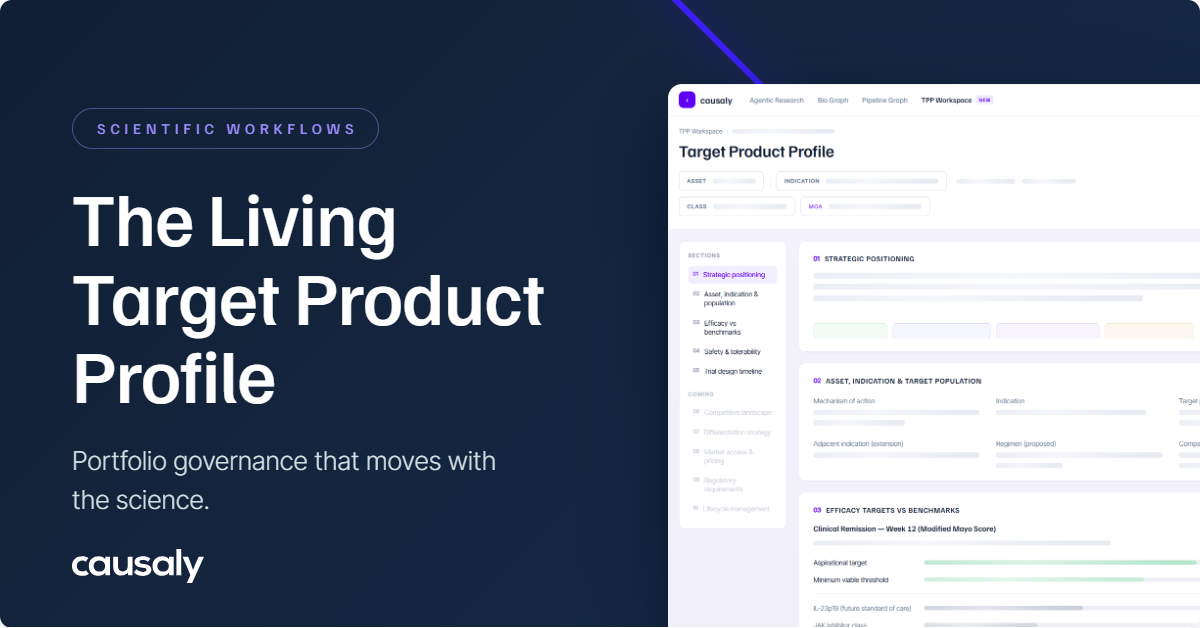
Most pharmaceutical portfolios are managed on documents that are out of date after the moment a committee reviews them.
Each asset carries a target product profile (TPP), a plan for what it needs to become. In most companies, that profile is rebuilt only at stage gates, sometimes years apart, and leadership ends up allocating capital against a picture of the asset that science has already moved past.
AI now makes it possible to keep every asset's TPP current and evidence-backed, turning portfolio management from periodic document reviews into continuous transparency across the portfolio, resulting in faster, better decisions on where to allocate capital.
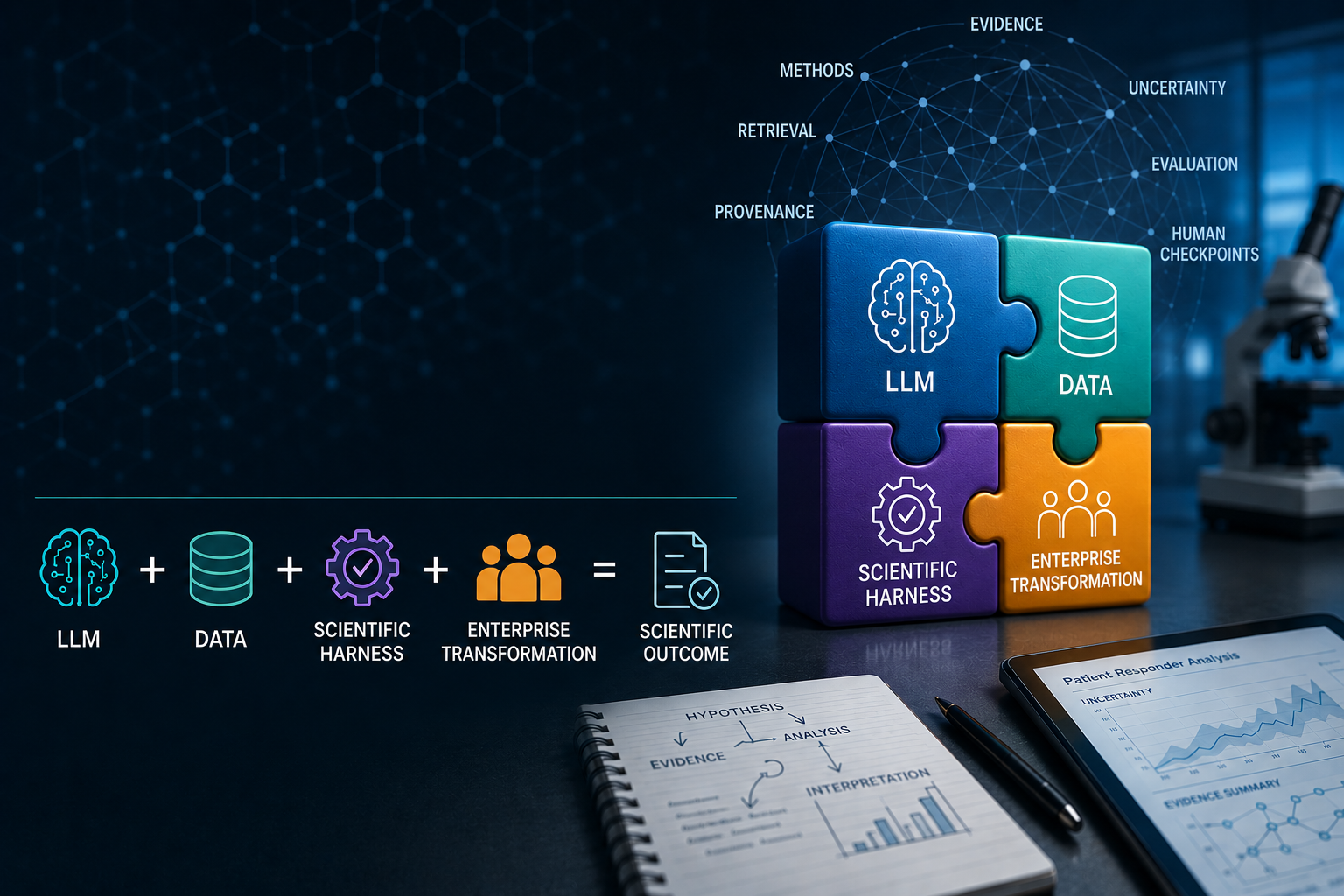
This is one of the governance-level workflows described in a previous blog when we laid out the three levels of scientific workflow, the level where the output is a decision and where AI only pays off once the way a company makes decisions changes too.
The TPP between stage gates
A target product profile (TPP) lays out what a program needs to become in order to be worth developing, including the indication and patient population it targets, the efficacy and safety bar it must clear, the dosing, and what would set it apart from competitors.
It's a key part of the document a decision-making body uses to decide whether an asset should advance and what results would justify the investment. Most organizations build it carefully at the start of a new project and only revisit it at the next stage gate, which can be years later.
While programs move through stage gates, the evidence continues to evolve. The standard of care shifts, competitors publish results, and new findings appear in the literature outside a team's own experiments.
Between stage gates, the asset leader is usually the only person tracking how these external developments affect their program. They may not see all of it, and they naturally tend to be biased when reading ambiguous signals in favor of their asset. Leadership only gets a structured chance to reassess when the next stage-gate review comes around, and until then has no independent view of what has changed or what it means.
Scarcity of resources created a second problem. Building one defensible TPP is expensive enough that most early-stage drug discovery programs get exactly one, scoped to the indication the team chose first, even when the underlying biology could support a much wider set of applications.
B-cell depletion is a live example, with CD19 and CD20 approaches showing reach across lupus, systemic sclerosis, and other autoimmune indications that no single profile written for one disease would capture. When an asset can only afford one profile, the portfolio is blind to the applications nobody scoped.
The living Target Product Profile
A continuously refreshed TPP keeps the same view current for all assets of the portfolio. Every attribute each profile claims, including the efficacy bar, safety risks, competitive set, and addressable indications, is tied to the external evidence that supports it, and that evidence refreshes as it changes.
This gives leadership an independent way to stay on top of the portfolio with the most up to date information at hand.
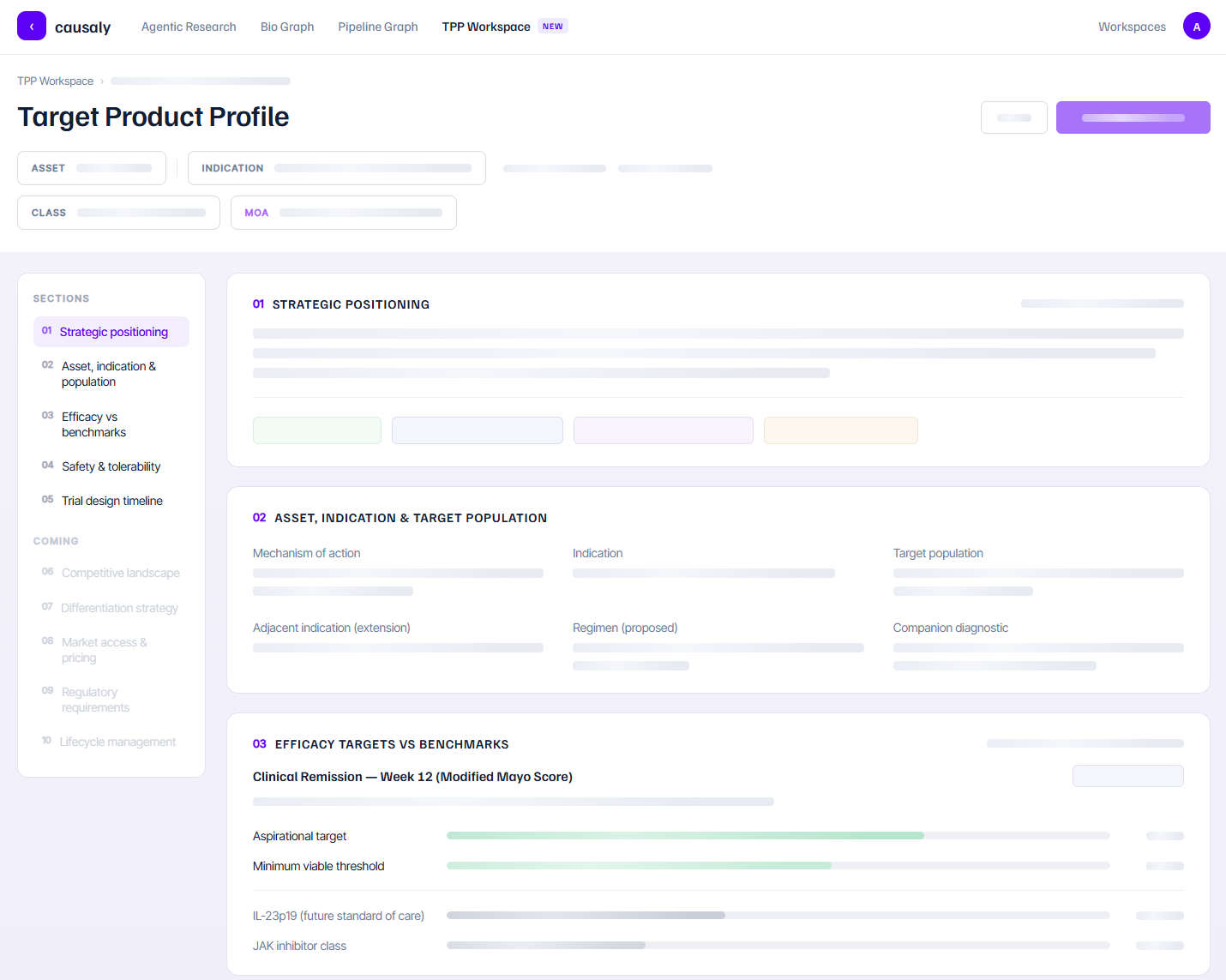
AI can now lower the cost of building and maintaining a TPP, so an asset can now carry more than one. Its biology can be scoped against the full set of indications it could plausibly serve, each with its own evidence and its own read on feasibility.
Probability of success across the portfolio
With up-to-date TPPs in place, the probability of technical and regulatory success (PTRS) stops being a number assembled manually before each review.
It can be maintained against current evidence and viewed across every program at once, so a decline driven by a competitor's readout or a shift in standard of care shows up when it happens, not at the next stage gate.
Leadership gets that visibility directly, seeing the same evidence the asset leader sees, along with the reasoning behind each PTRS, not just a single figure in a slide.
Assets are expressed in common terms, so they can be ranked and compared, and capital can move toward programs with growing evidence and away from those whose thesis is eroding. Because each asset carries its full set of plausible applications, the portfolio can weigh options that a single-indication profile would never put in front of a decision maker.
This is where AI in R&D becomes an executive conversation. The choices that create value- committing an asset to proof of concept, moving a program into Phase 1, reallocating toward a stronger opportunity- all turn on a credible read of probability of success, and on seeing it early.
A portfolio managed on living TPPs gives leadership that read, and a defensible basis for the calls that follow.
If you lead an R&D portfolio, the question is which of your assets can you describe accurately today without reopening the file, and how many stage gates separate that description from what's actually true.
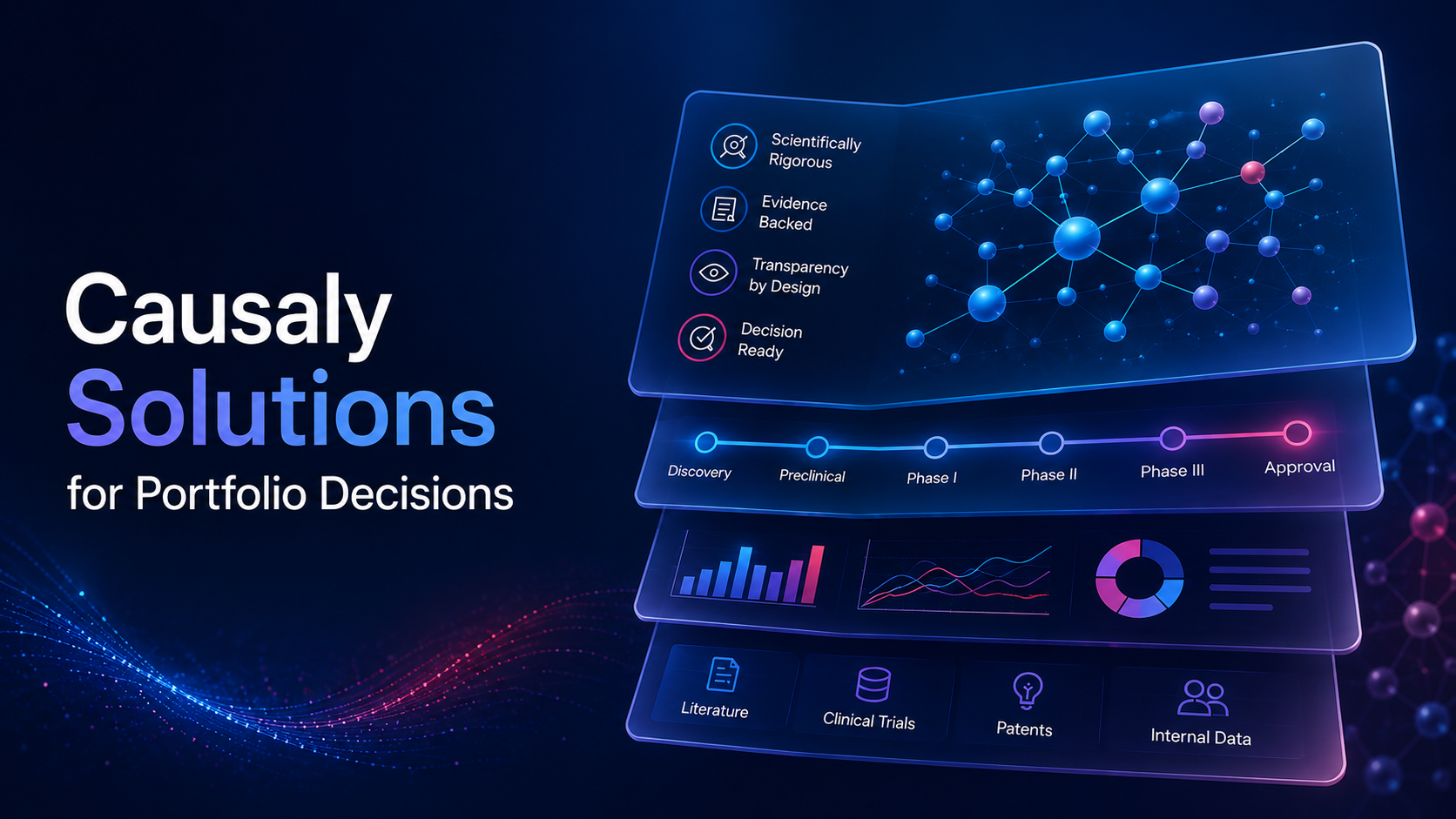
At Causaly, we're building this with R&D organizations. Two high-precision knowledge graphs, combined with a wide set of connected sources, power end-to-end workflows that keep each asset's profile current and assess the complete external landscape independently of the asset team's own narrative, giving leadership a rigorous, external check on every proposal before capital moves.
If a continuously up-to-date approach to TPPs sounds like an idea worth exploring for your assets, book a meeting to speak to our solutions experts.
Further reading
.png)
.png)
.png)


Get started with Causaly
Ready to transform the way your R&D teams discover and deliver? Take the first step - see Causaly for yourself.
Request a demo