How Custom AI Workflows Support Target Product Profile (TPP) Evidence Generation and Portfolio Decisions
The evidence layer underneath a TPP is where most of the research effort lives
Most early-stage AI deployment in pharmaceutical R&D has targeted a specific variable, how long a research task takes. Competitive landscaping, target characterization, and unmet need analysis are time-intensive, and automating them produces real efficiency gains for scientific teams.
The decisions that most affect program value depend on something else. Choices about which indication to pursue, how to shape a Target Product Profile, and whether an asset should advance through portfolio review are constrained by the rigor and cross-functional integrity of the evidence behind them, not by how quickly that evidence can be produced. Speeding up evidence generation leaves the structural problem in place when the process cannot reflect an organization's own methodology, incorporate proprietary data, or produce an output that clinical, commercial, regulatory, and medical affairs teams can use without reconciling it against their own version.
Causaly Solutions is built for that class of decision.
When a generic output stops being enough
A decision has crossed into this category when one of four conditions applies.
The methodology cannot be templated. The decision requires an organization's specific logic for weighing conflicting signals, its own criteria for what counts as sufficient evidence, and its judgment about which dimensions of a competitive landscape matter most for a given asset. A generic process produces a generic output, and the decision requires a specific one.
The output has to travel across functions without losing integrity. Clinical, commercial, regulatory, and medical affairs teams need to reach governance moments working from the same evidence base, in a form each function can use directly. Outputs built for one function typically require rework before a second team can act on them, and that rework introduces inconsistency at the point where consistency matters most.
The output feeds a formal governance moment. When a committee, a portfolio review, or a regulatory gate depends on the evidence a team presents, that evidence needs to be structured, auditable, and independent of the team presenting it. A governance chair needs material they can interrogate, and a team with a vested interest in the outcome cannot be its own source of record.
Answering the question requires internal context. Prior development decisions, internal pipeline data, and proprietary research shape what "differentiated" and "achievable" mean for a specific asset. Evidence drawn only from public sources cannot produce the right answer, because it is missing the context that makes the question specific in the first place.
What a full-stack solution requires
Meeting these conditions takes more than a configured workflow.
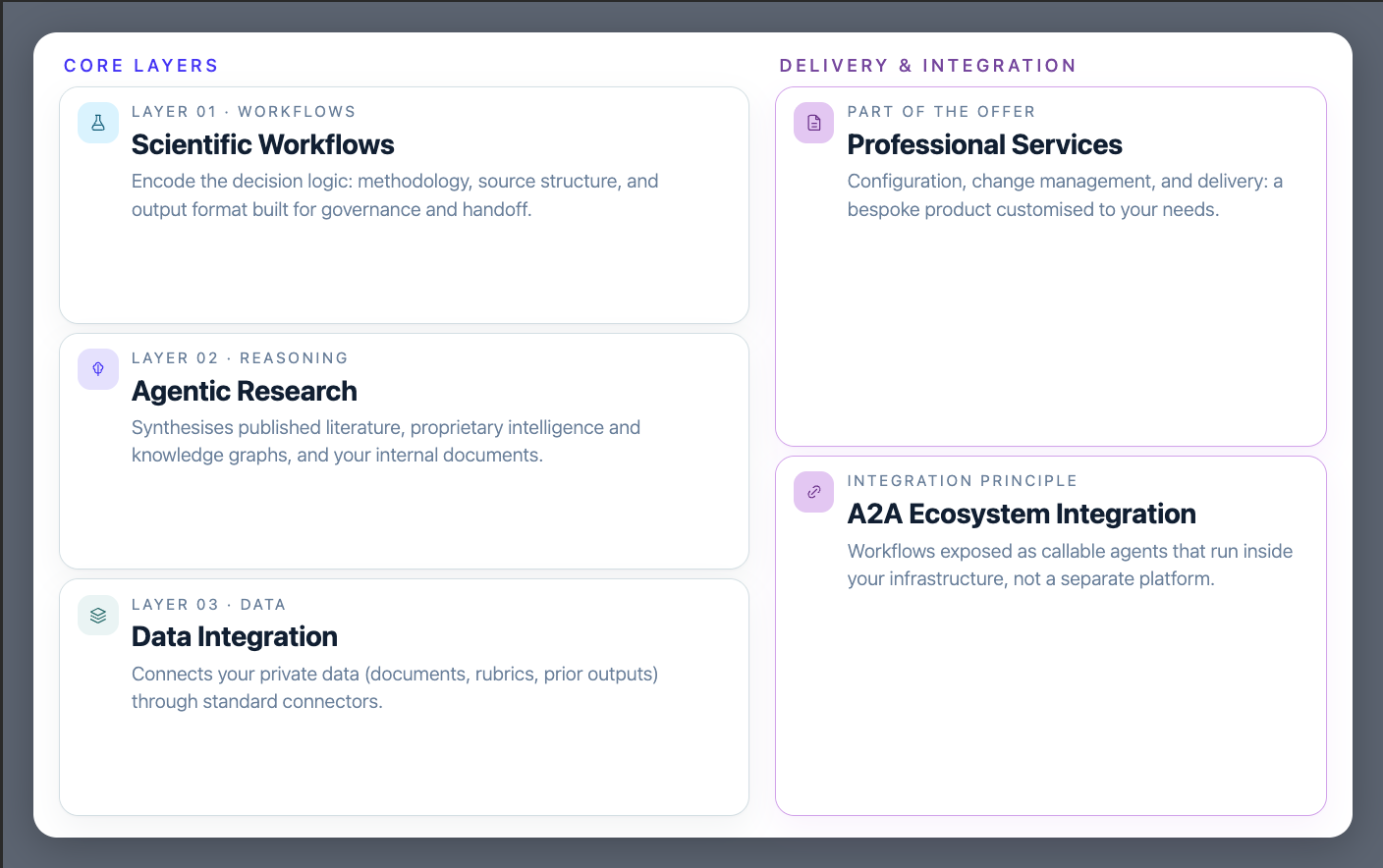
Scientific Workflows encode the decision logic, with the methodology formalized, the source structure defined, and the output format designed for governance and downstream handoff. Agentic Research provides the reasoning layer, synthesizing across published literature, Causaly's proprietary competitive intelligence and biomedical knowledge graphs, and internal documents at a scope manual research cannot match. Data Integration connects an organization's private and proprietary data, including internal documents, decision rubrics, and prior outputs, through standard connectors, so the evidence layer reflects the organization's actual context.
Two additional elements complete the offer. Professional Services covers configuration, change management, and delivery, since this is a bespoke product customized to an organization's needs. Through A2A Ecosystem Integration, workflows are exposed as callable agents that operate inside the customer's own infrastructure rather than routing work through a separate platform.
Where this category of decision sits
Not every research task carries these characteristics, and the boundary matters for deploying the right kind of solution.
A two-axis view helps clarify it, weighing how much organizational change is required to adopt and use the solution against how much judgment complexity the decision involves. Evidence assembly work, including literature synthesis, competitive monitoring, and systematic reviews, sits in the high-evidence, lower-judgment quadrant and is well served by standardized workflows with full provenance. Management judgment decisions, including portfolio prioritization and go/no-go calls, sit at the far end of judgment complexity and resist codification altogether. Custom Solutions addresses the territory in between, where evidence requirements are high, judgment is organizationally specific, and the output has to hold up across functions and governance processes.
Target Product Profile evidence generation
TPP evidence generation is the clearest example of what a custom solution addresses.
A Target Product Profile is the central organizing document for a drug development program. It defines what a product is designed to achieve across clinical, commercial, regulatory, market access, and manufacturing dimensions, and it is the document each of those functions has to work from at the same time. One document serving multiple functions, each with different evidentiary needs, places the TPP outside what a standard workflow can deliver.
The evidence layer underneath a TPP is where most of the research effort lives, including mapping the competitive landscape at the projected launch window, benchmarking achievable efficacy against historical precedent, characterizing the safety profile at relevant doses, understanding the regulatory pathway and what it requires, and assessing the market access environment the product will enter. Each dimension draws from a different evidence base, evolves as the field moves, and has to cohere into a single picture that every function can use without building its own version.
Because an organization's development history, portfolio decisions, and internal data shape what "differentiated" or "clinically meaningful" means for a specific asset, that picture requires proprietary context that public sources alone cannot supply.
Causaly automates the evidence layer, producing a source-cited, structured intelligence base across every TPP dimension, updated as the competitive and regulatory environment evolves. Teams direct their effort toward the judgment calls the evidence informs, including which efficacy level to target, which safety signals require a management strategy, and what the regulatory approach should be. The TPP becomes a document that updates when a competitor reads out or a regulatory precedent shifts, rather than one requiring a full coordination cycle to refresh.
The pattern Custom Solutions is built to break
The decisions that most affect program value are also the decisions most often rebuilt from scratch, by whoever is available to run the analysis when the deadline arrives. Custom Solutions addresses the cause of that pattern, the absence of an encoded methodology, a cross-functional output format, or a way to bring in internal context.
Causaly works with R&D organizations to define, build, and deploy these workflows. Request a meeting to discuss what a solution would look like for a specific decision your team runs today.
Further reading

.png)
.png)

.png)


Get started with Causaly
Ready to transform the way your R&D teams discover and deliver? Take the first step - see Causaly for yourself.
Request a demo