Knowledge Graphs for Deeper Scientific Reasoning in Drug Discovery
A BTK question put to a general-purpose AI model and to Causaly Agentic Research shows how knowledge graphs make answers more complete, deeper and easier to check.

A BTK program and the question it raises
A therapeutic area head preparing for a portfolio review, a preclinical program lead building the case for the next stage of funding and a principal scientist defending a target proposal share the same problem. Each decision weighs where a program stands among competing approaches against how well the science supports it, so each calls for a complete view of the drug landscape and a working understanding of the disease biology and the mechanism of the target.
Consider the question that a BTK program has to answer.
Where do next-generation BTK inhibitors differentiate from ibrutinib in the biology they act on, and what does this imply for where a hematology pipeline competes?
A complete answer triangulates pipeline databases, trial registries, patents and the primary literature into one picture of the mechanistic biology and the competitive position of the pipeline, and that assembly normally takes a team weeks. AI compresses that cycle and raises the number of targets validated or disease areas explored, which makes questions like this a natural entry point for AI in R&D. The quality of the answer then depends on where the system starts, and a general-purpose AI model starts from nothing.
The same question was put to a general-purpose AI model and to Causaly Agentic Research with its Pipeline Graph agent. The sections below compare what came back, finding by finding, so that each claim can be checked against the two answers.
The two answers at a glance
Both answers are organized and read with confidence. The table shows where they differ, and each row maps to a finding below.
| What the decision needs | General-purpose AI | Agentic Research with Pipeline Graph |
|---|---|---|
| Comprehensiveness: is the whole field in view? | 3 programs, one drug class missing | 10 programs across all four classes, from about 300 screened |
| Depth: will each claim hold up in review? | Drug names only | Each program backed by its record, documents and trials |
| Context: does the landscape connect to the biology? | Limited to what the retrieved pages state | Each program linked to the kinases and signaling networks around the target |
| Transparency: can the answer be checked? | Web pages cited, limits not stated | States the data sources used and where its evidence ends |
This article examines where generic AI systems fall short, and why knowledge graph agents lead to more complete, deeper and more insightful answers.
The three findings below follow the rows of the table, taking comprehensiveness and depth in turn and then context and transparency together, since these are the qualities that decide whether a team can carry an answer into a review and defend it.
Finding 1. The general-purpose answer covered 3 of 10 relevant programs and left out a drug class
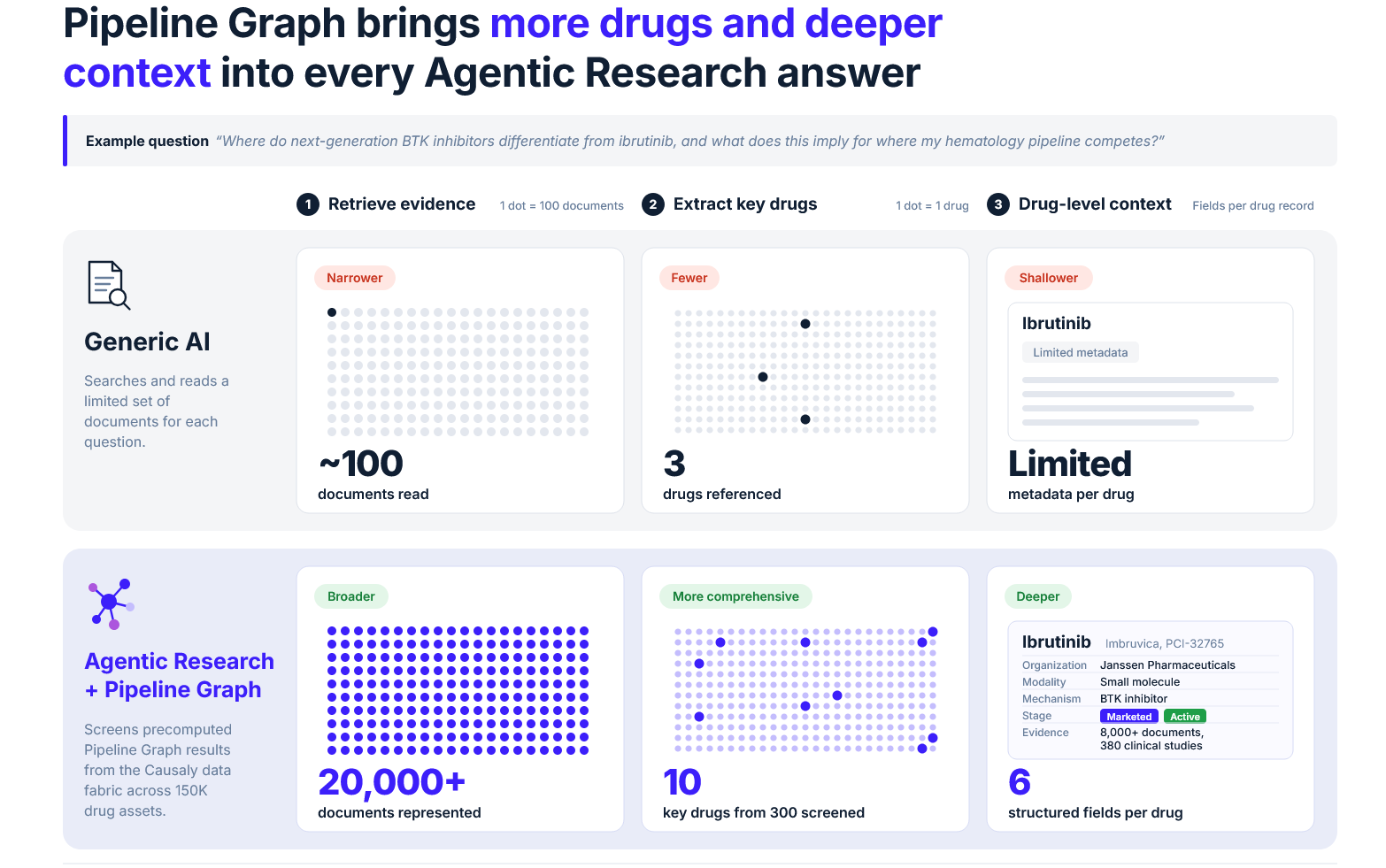
A general-purpose model builds its comparison from the drugs that the documents it retrieves mention most prominently, and search ranks recent, well-covered programs first. Early programs surface only in a patent, a pipeline update or a trial record, and discontinued programs rank lower still. Connectors can bring in specialist sources, although little structured knowledge about drugs, targets and pathways exists before the search begins, so the set of programs the model can compare is fixed by what the search happened to return.
For the BTK question that set was three drugs, each carrying little more than a name, with the BTK degraders absent as a class. An agent built on a knowledge graph starts from a landscape that has already been assembled. For the same question the Pipeline Graph agent screened about 300 BTK-class drugs and referenced the ten most relevant, grouped into first-generation covalent inhibitors, more selective covalent inhibitors, noncovalent inhibitors and degraders. Early and discontinued programs sit in the same records as marketed drugs, so they enter the comparison without anyone having to search for them.
Reviewers check what is in front of them, so a program that was left out of the answer never gets questioned. With the degraders missing, the field looks less crowded than it is and next-generation inhibitors look more differentiated than they are, since the approaches that would crowd them never entered the analysis. The earlier inhibitors, which carry the evidence on selectivity and limits that newer programs inherit, are the ones a search ranks lowest. Every competitor using the same tools can receive the same answer with the same gaps, so it cannot serve as the basis for an edge.
The same coverage applies to the biology. BioGraph connects BTK and ibrutinib to the genes and proteins around them. ITK, EGFR and TEC appear next to ibrutinib, with SRC-family kinases and BLK as further neighbors, and each sits in a different signaling network, from T-cell receptor signaling to platelet signaling. These neighbors show where selectivity and safety questions are likely to arise, which a dedicated safety assessment would then examine. Missing assets leave a blind spot in the competitive set, missing genes leave an unclear view of the biology, and either gap can carry severe implications for a program.

Finding 2. Each referenced program arrives as a record with its evidence attached
Having the right drugs in the answer is the first step, and the second is knowing enough about each one to stand behind it in a review. In a structured record, ibrutinib is a single entity. Its synonyms and development codes resolve to the same asset, and the record holds organization, modality, mechanism and stage, linked to 8,000+ documents and 380 clinical studies, with findings, milestones and drug history opened directly from the answer. A comparison that lists only names creates extra work for the team, who then have to look up the details on each drug before the review.
On the biology, the BTK run surfaced points that change how a comparison reads. Prolonged BTK inhibition can lower distal signaling while proximal phosphorylation rises, a pattern described as BCR rewiring, so time on drug and the node measured both shape what a study appears to show. One early covalent inhibitor did not inhibit EGFR or ITK in cellular experiments where ibrutinib does. A study on binding mode found that two inhibitors can match on proximal phosphorylation and still differ on calcium mobilization. An early reversible inhibitor blocked BCR-driven B-cell proliferation and reduced FcγRIII-induced IL-1β production in macrophage assays. Each point gives the team a more precise way to say how a newer program differs from ibrutinib, and each is cited to the study that reported it, so a scientist who disagrees with the reading can open the source and argue from it.
Finding 3. Landscape and mechanism arrive in one answer, with the evidence open to inspection
To answer the BTK question, Agentic Research queried Pipeline Graph for the drug landscape, BioGraph for the relations between drugs, genes and pathways, Reactome for pathway detail, and ChEMBL and the scientific literature from the Causaly data fabric for compound and experimental evidence, and combined what each source returned.
The result is a single answer with the full drug landscape, how each acts on BCR signaling, and the other kinases that move alongside them. A drug record gains meaning once its off-target kinases are known, and a pathway gains relevance once the programs acting on it are visible. Without that combination the team receives a landscape with no mechanism or a mechanism with no landscape, and assembles the missing half from separate tools before the review. A general-purpose model has no equivalent step, because it holds no structured landscape or pathway model to route between, so the connection between a program and its biology is only as good as the documents that happened to state it.
The graphs serve as a foundation that lets the agent move between structured records and primary sources, pursue an unexpected finding where one appears, and report where more research is needed. The answer names the data sources it used and states where its evidence ends, so the team brings those limits into the review already identified. A general-purpose answer that states no limits can read as complete, although it reflects only the documents that the search returned.
Reaching the evidence in primary sources depends on a scientific harness built to find the right passage in a long paper and to read the experiment behind each result, which is why the agent returns each point with the study that reported it. The records it cites resolve to the same entries on every run, so a figure quoted in a review can be reopened later and found unchanged.
Conclusion
When every team has access to the same AI models, the edge comes from what the model starts with. A general-purpose system draws on the open web and the published literature that every competitor can reach, so teams that rely on it receive answers that converge. An agent that starts from structured, evidence-linked records of drugs, targets and pathways begins the same question from a different place, and returns more complete, richer answers. Decisions on target selection, competitive positioning and early safety review then rest on the full field and the biology behind it, and decisions made on more complete evidence change the outcomes of a program.
The method behind the BTK comparison is set out in the appendix.
Appendix. Method
The comparison in this article rests on one BTK question put to both systems. The details below allow a team to repeat it on a question of its own.
| Item | Detail |
|---|---|
| Question | The BTK question quoted at the top of this article |
| Systems compared | A general-purpose AI model that searches the open web, and Causaly Agentic Research in production with Pipeline Graph, BioGraph, Reactome, ChEMBL and the scientific literature from the Causaly data fabric available as sources, with access to all available MCPs and connectors |
| Prompt | The same question for both systems, with Agentic Research directed to use Pipeline Graph, which a general-purpose model lacks |
| Dimensions compared | Programs referenced, drug classes covered, detail held for each program, biology connected to the target, and the data sources and limits that the answer states |
| Repeatability | Pipeline Graph records cited in the answer resolve to the same entries on every run, while answer-level determinism is not claimed because answers can vary between runs |
Further reading




Get started with Causaly
Ready to transform the way your R&D teams discover and deliver? Take the first step - see Causaly for yourself.
Request a demo