Choosing the Next Indication Requires a Different Kind of Assessment
How evidence requirements and decision criteria evolve across indication identification, selection, and expansion.
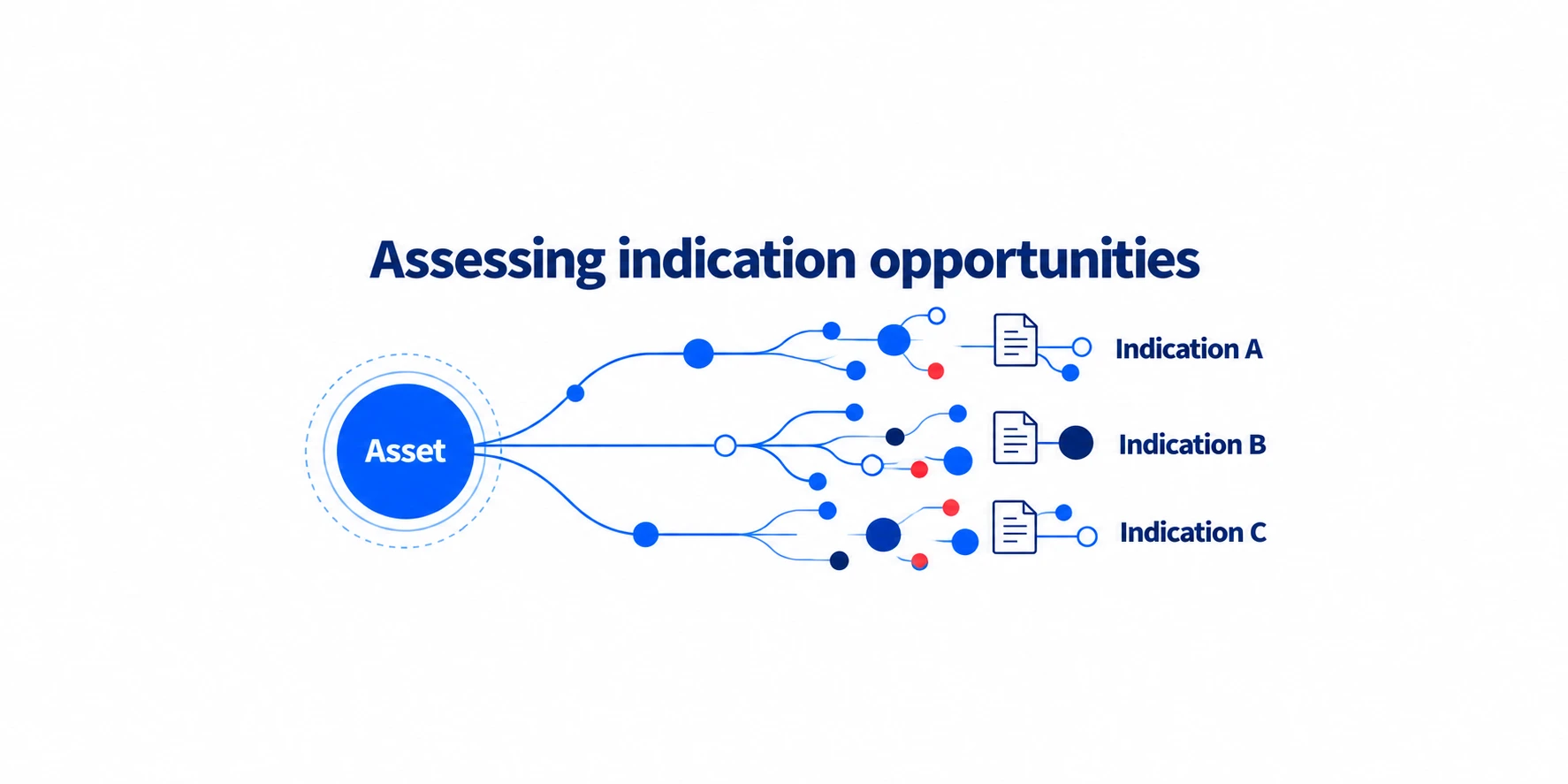
Deciding which indications an asset should pursue shapes its development path and the patients it could benefit. Teams make these decisions throughout the asset’s lifecycle, from identifying diseases where its mechanism could be effective, to selecting an indication for development, to evaluating additional indications for an existing asset.
A study published in Nature estimated that drug mechanisms with genetic support have a 2.6-fold higher probability of clinical success than those without. That relationship varies across therapeutic areas and development phases, highlighting the need to assess the biological case for each opportunity.
But the criteria used to choose an initial indication will not fully answer where an established asset should go next. Indication prioritization needs a shared method, with evidence requirements and weighting shaped by the asset’s stage and the organization’s priorities.
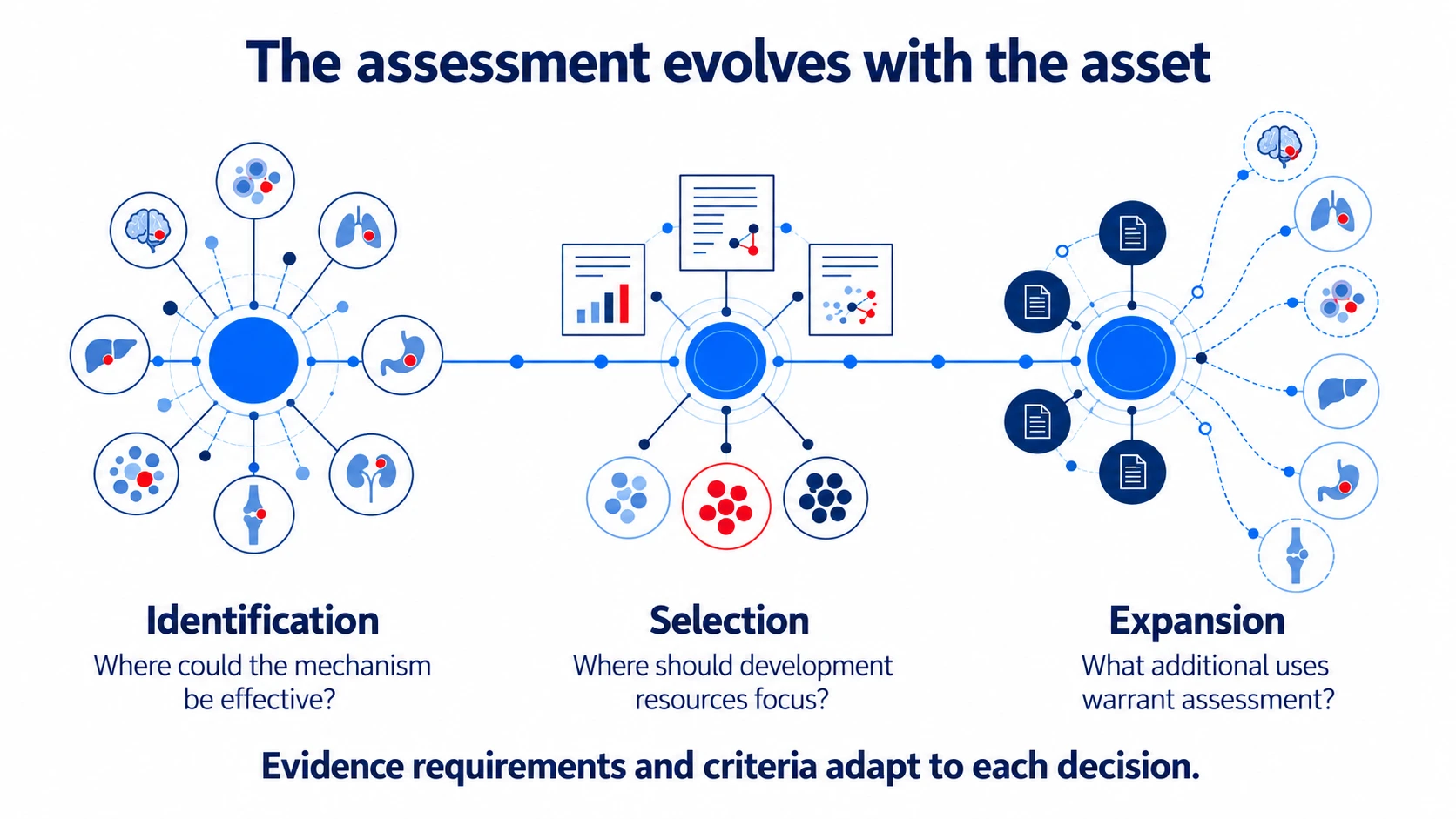
The question evolves with the asset
Early in development, indication identification focuses on which diseases a target or mechanism could help treat. Teams assess the biological rationale, including whether the asset’s pharmacology could affect disease processes in a way that benefits patients.
As findings from the program emerge, the focus shifts toward indication selection. Teams weigh this evidence alongside safety, clinical feasibility, unmet need, and competition to decide where to commit development resources. This assessment may narrow an initially broad disease opportunity to a defined patient population.
For an existing or late-stage asset, indication expansion builds on what the program has already established to evaluate additional uses. Teams examine how well those findings apply to another disease or population and what further evidence is needed to support development.
Each assessment produces a prioritized shortlist, but the evidence available and the criteria for proceeding evolve with the asset.
Why teams struggle to standardize the work
These changing requirements make it difficult to agree on a single process across teams. In discussions with a large pharmaceutical company, Causaly heard how groups had struggled to define a standard indication workflow because each approached the work with different objectives and methods.
Those differences also affect how evidence is gathered and assessed. Contributors draw on literature, clinical findings, competitive information, and internal expertise, but may apply different standards for what is sufficient to support a recommendation. Decision owners then have to reconcile the assessments before they can compare opportunities.
The process must also allow teams to revisit earlier judgments. A safety finding may change which patients are suitable for treatment, while a competitor result may alter the unmet need. A shared method therefore needs clear criteria for comparing opportunities and enough flexibility to reassess them as the evidence develops.
Evidence availability can shape the shortlist
Both scientific potential and the volume of available research can influence which indications make the shortlist. Diseases with extensive published research may attract more attention, while less-studied opportunities can be overlooked.
A data science and AI director at a top-20 pharmaceutical company described repeatedly proposing similar oncology indications because so much data was available. His observation highlights how well-studied diseases can dominate the opportunities considered.
Less-studied indications may receive less attention, leaving their potential unresolved. AI can help teams examine evidence across a broader range of diseases, surface possible mechanistic connections, and identify gaps that warrant further research. These findings can give teams a basis for assessing opportunities beyond the usual shortlist.
Evaluating these opportunities requires teams to assess mechanistic support separately from research volume, and market opportunity separately from unmet need. This helps distinguish an indication with unfavorable findings from one that remains insufficiently studied, so the recommendation reflects both the evidence available and the uncertainty that remains.
Configure the criteria and make the recommendation clear
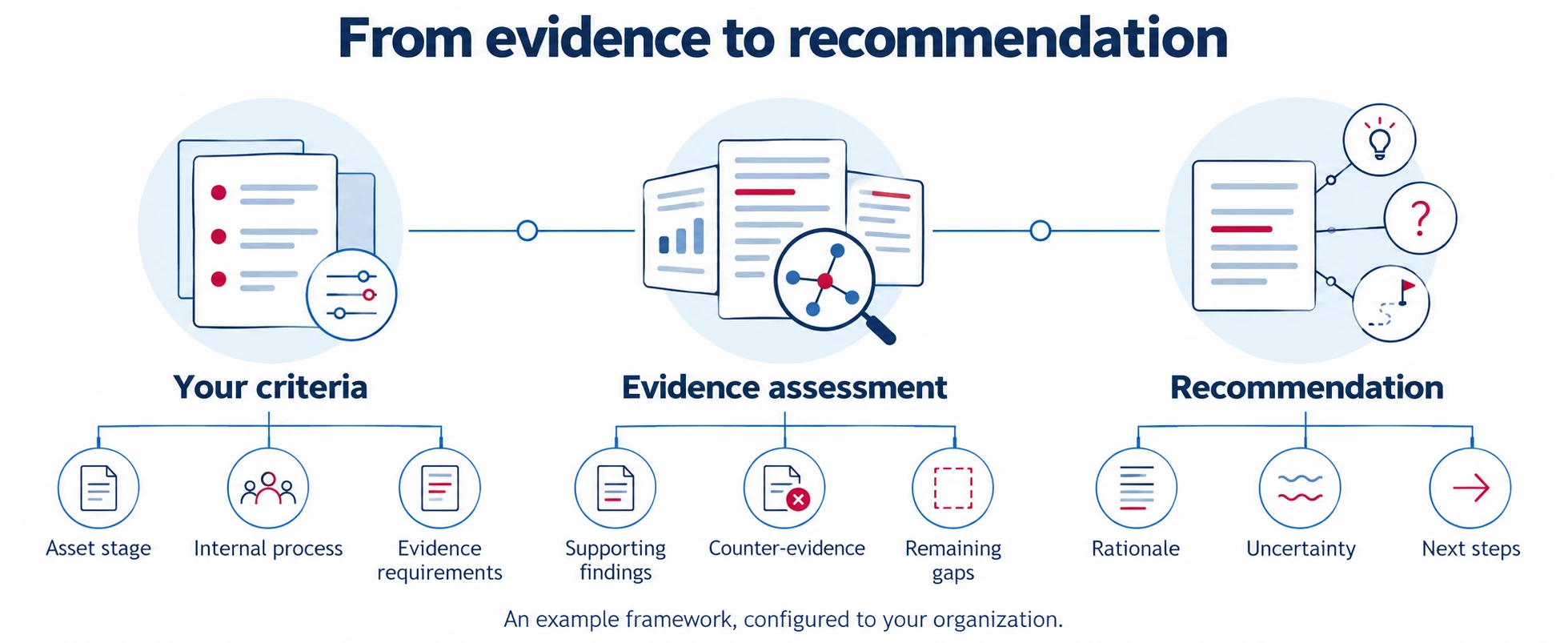
Making these distinctions part of a repeatable method requires agreement on what the assessment must resolve. The organization defines the criteria, how much weight each carries, and what evidence qualifies for each score. These choices reflect the asset’s stage and the development commitment being considered.
Each company can define recommendation categories that reflect its internal processes and decision criteria. For example, the assessment could group indications into the following categories, with supporting evidence and reasoning for each.
- Prioritize when the evidence supports committing development resources.
- Explore in a narrow segment when further work is warranted in a defined patient population.
- Monitor / hypothesis only when the biology is promising but further evidence is needed.
- Do not pursue when a specific disqualifying issue has been identified.
The recommendation carries the supporting evidence, counter-evidence, and remaining gaps into review. Inference is labeled, and the scoring criteria and calculations are available for scrutiny. Scores provide directional support for comparison without implying a forecast of development success.
This allows a governance committee to examine why an indication received its position, challenge the assumptions behind it, and understand what new evidence could change the recommendation. The scientific requirements behind this approach are explored further in Indication Expansion: What a Scientifically Rigorous Analysis Requires, and What It Can Leave Out.
How Causaly supports indication prioritization
Causaly’s Indication Prioritization solution puts this approach into a workflow configured to the organization’s decision. It brings together literature, biological relationships, competitive intelligence, and relevant internal information to assess opportunities against the team’s criteria.
Causaly’s PhD scientists work with the organization’s experts to define the starting point, weighting, scoring standards, and output format. The method is validated with the team and maintained as evidence and organizational needs change, so it continues to reflect how the organization evaluates its assets.
Initial feedback from large pharma teams has helped refine the approach, highlighting the value of the ranked opportunity table and the guidance explaining when an indication should not be pursued.
For leaders accountable for indication choices, this provides a repeatable assessment that adapts to the asset while keeping the evidence and reasoning available for review.
Discuss an indication decision your team is working through and how Causaly could support it.
Further reading








Get started with Causaly
Ready to transform the way your R&D teams discover and deliver? Take the first step - see Causaly for yourself.
Request a demo