How Should Scientists Evaluate AI Answers in Drug Discovery?
Ramon Perez, Senior Scientific Advisor at Causaly, explains how scientists can judge AI answers by the evidence behind them, improve evidence handoffs between teams and protect the curiosity that drives discovery.

AI answers should be judged by the evidence behind them, including whether the sources support each claim, where studies disagree and what remains uncertain. For Ramon Perez at Causaly, the risk is that a well-written answer can make weak evidence look convincing.
Ramon brings a bench scientist’s perspective to that problem. With a PhD in molecular genetics and microbiology, his research spanned Epstein-Barr virus, hantaviruses and SARS-CoV-2. During the pandemic, he began explaining virology to scientific and non-specialist audiences, developing an interest in how research reaches the people who need it.
That interest led him to Causaly, where he works with scientists across therapeutic areas. Having read around 370 papers for his dissertation, he understands the effort involved in assembling evidence and the judgment needed to decide what it supports.
In this Q&A, Ramon explains how scientists can assess AI outputs, improve evidence handoffs and protect the curiosity that drives discovery.
Answers adapted from the interview for clarity and concision.
What makes an AI answer useful for a scientific decision?
A useful answer gives you a conclusion you can defend, with evidence you can inspect. Finding relevant papers is part of that, but scientists also need to understand contradictions between studies, differences in methods and gaps in the literature.
The biggest gap I see is how AI communicates the confidence a scientist should place in an answer. A response can read beautifully while the underlying evidence is limited. That can lead people to trust it too readily, while someone who encounters a fabricated claim may dismiss the technology entirely.
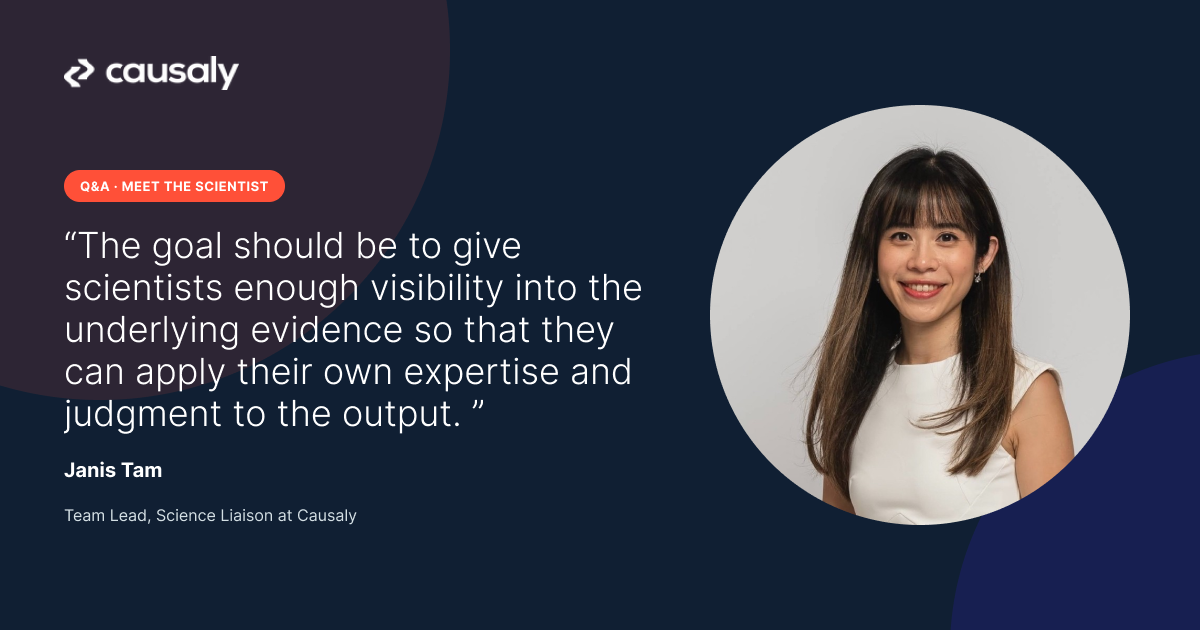
Confidence should reflect the strength of the evidence. Scientists need to see what supports a conclusion and where they still need to exercise judgment.
How should scientists check an AI-generated research summary?
Treat an AI summary with the same scrutiny you would apply to a scientific paper. Follow the claims back to the original research and examine whether the data supports the interpretation.
My approach is to read the abstract for context, then look at the figures and methods before accepting the authors’ conclusions. What was measured? How was the experiment conducted? Does the result justify the claim being made?
A published paper can overstate its findings, and an AI summary can carry that interpretation forward. Whether I am using Causaly or a general-purpose model, I still need to examine the source material. The ability to recognize weak evidence, bias and unsupported conclusions remains central to scientific work.
Why does the same AI tool work for one research team and fail for another?
Different research teams need different kinds of support. An AI tool should be evaluated against the work a scientist needs to complete.
A wet lab scientist might need to understand an unexpected result, find a relevant method or design a follow-up experiment. A computational biologist may need to analyze large datasets and prioritize findings for experimental testing. Those tasks require different capabilities.
I have worked with teams running advanced agentic pipelines and others still sharing papers by email. A tool dropped into either setting without understanding the work can be judged poorly because it does not fit the task.
The starting point should be the scientific problem and the people responsible for solving it.
How can AI improve evidence handoffs between scientific teams?
AI can help prepare a structured evidence draft that a subject matter expert can review, reducing the work needed to assemble and explain the findings.
Access to specialist expertise is often a bottleneck. A team may have gathered relevant evidence but still need someone with deeper knowledge of the biology or therapeutic area to assess it.
Researchers have described using AI with an embedded scientific framework to prepare dossiers outside their immediate specialism. This helps them organize the evidence and present a coherent draft for expert review.
The expert can then focus on the interpretation, missing evidence and revisions that matter. The quality of that handoff depends on keeping the supporting sources traceable so the reviewer can check how the conclusions were reached.
What scientific skills become more important as AI takes on more work?
Critical appraisal, problem framing and experimental design become more important as AI handles more evidence gathering and first-draft writing.
I expect scientists to spend more time deciding which questions are worth pursuing, which experiments are worth running and how to interpret the findings surfaced by agents. Supervising a multi-step workflow still requires someone who can recognize when an assumption is weak or a result needs further examination.
That also means being comfortable saying “I don’t know”. A convincing answer does not give me expertise in an unfamiliar area. I remain accountable for the claims I use and need to recognize when further reading or specialist input is necessary.
Could AI make scientific thinking too similar?
That is a risk if teams rely on the same models, frame questions in the same way and accept similar answers without exploring further.
Some of the most useful scientific ideas come from reading something outside your immediate focus and noticing an unexpected connection. If we optimize too aggressively for relevance, we could lose those opportunities.
Scientists need room to follow surprising findings and challenge their original assumptions. AI can help surface evidence, but we should remain curious about what sits beyond the answer it provides.
Where could agentic AI make the greatest difference in research?
The opportunity I see is to make established scientific approaches easier to apply across teams while keeping expert review central to the process.
Different groups bring valuable experience to the same problem, but that expertise can be difficult to share. Encoding established methods into workflows could give more researchers access to a structured approach for gathering evidence and assessing it.
What excites me most is closing the gap between what is known and what gets used. Relevant findings can remain buried in the literature while teams work on questions those findings could help answer. Making that evidence accessible, understandable and open to scrutiny is where AI can make a meaningful contribution.
Further reading



Get started with Causaly
Ready to transform the way your R&D teams discover and deliver? Take the first step - see Causaly for yourself.
Request a demo