Building an AI Scientist Around the Work R&D Needs
Defining the assignments an AI scientist should complete helps R&D teams assess its capabilities, review its work and determine where scientific judgment is required.

Every R&D organization has scientific questions it would pursue if it had the capacity to follow them through. An AI scientist can expand that capacity by carrying an assignment from data analysis through scientific interpretation to a work product that a team can examine and use.
In my recent posts, I looked at computation and scientific interpretation from the perspective of how a system processes a scientific problem. Computation produces a result from specified inputs, while interpretation examines what that result means in a biological context. Defining the assignment that requires both gives us a practical way to specify what an AI scientist must do and how its work should be assessed.
A scientific assignment can pass through several kinds of work before it is complete. Consider a team that wants to use an omics dataset to prioritize targets for a program review. It needs the data analyzed and the resulting signals interpreted before the reviewed evidence is presented in a target memo. The completed assignment becomes a unit of delegation with different standards for completion, and defining those standards helps the team decide how much an agent can carry through and where a scientist needs to intervene. Five categories help make those requirements concrete, and a single assignment may combine several of them.
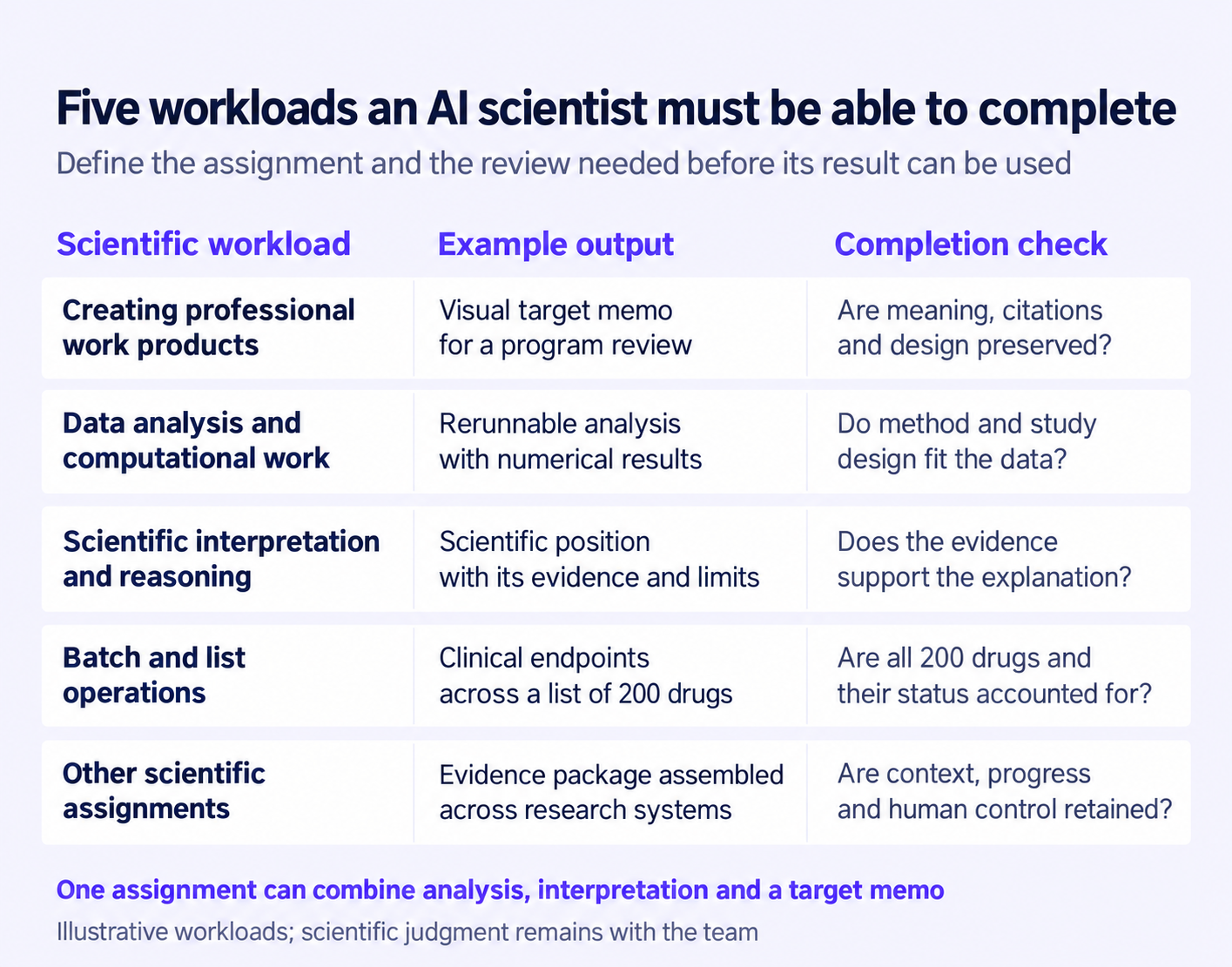
Data analysis and computational work
The data analysis and computational workload turn measurements into scientific signals. Starting with a dataset and its study design, the agent selects an appropriate method and writes or runs the analysis needed to produce a result. In our omics-to-target assignment, this means analyzing the experimental data to identify expression patterns that a scientist can investigate.
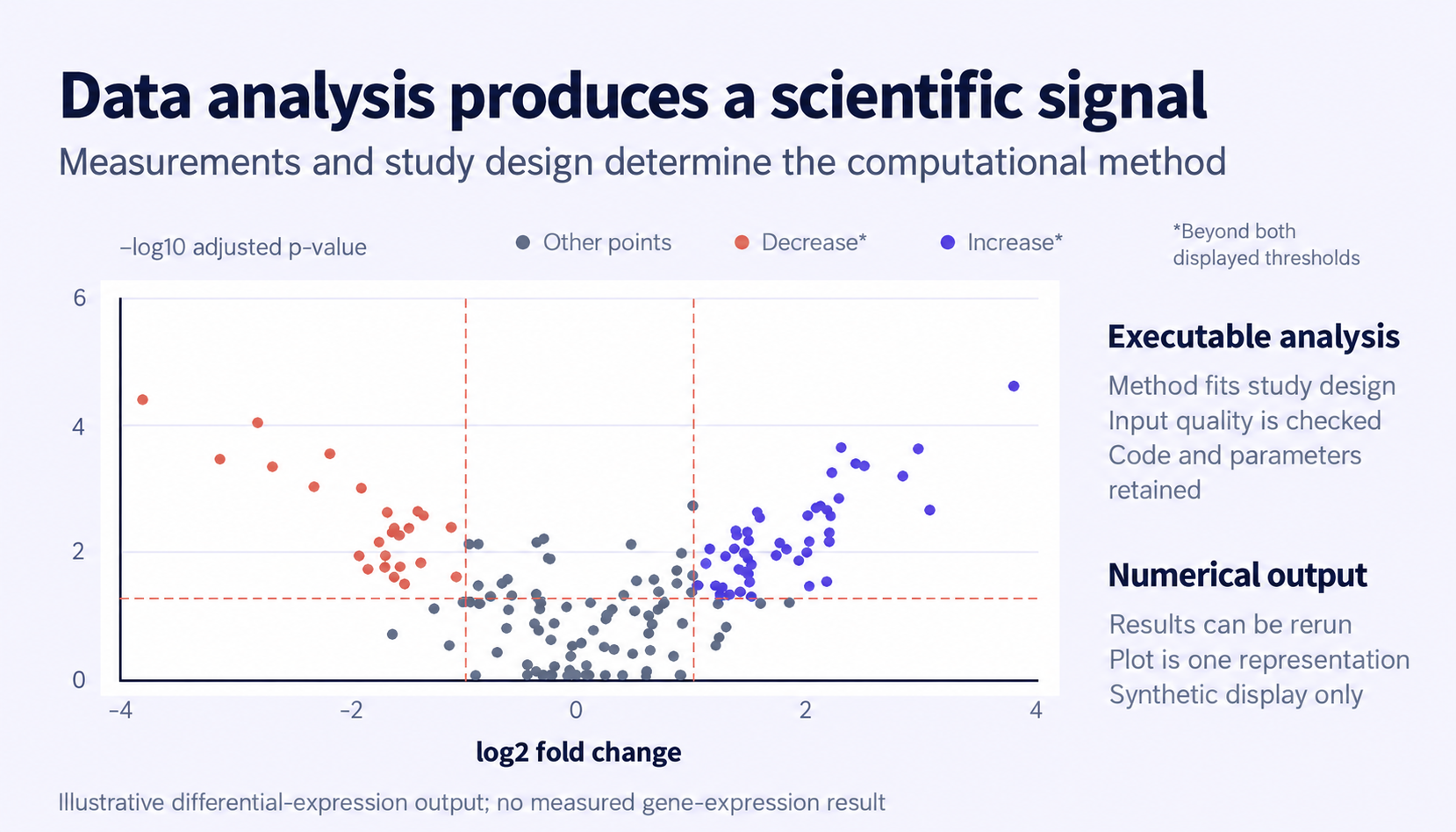
Making that analysis executable involves work on the data as well as the method. The agent may need to reconcile files before it can apply the calculation, and it has to check whether the inputs support the intended comparison. The resulting analysis needs to show how the data were prepared, which analytical choices were made, and whether the method’s assumptions were met.
The analysis should be reproducible, with the code and analytical choices available to another scientist. A plot is one way to inspect its numerical output, while the computational assignment includes the method and the results behind it. Understanding what the signal means in the biology requires the scientific interpretation workload that follows.
Scientific interpretation and reasoning
An analysis produces a signal, while scientific interpretation takes that signal into its biological context. In the target-prioritization assignment, the agent has to examine what an expression pattern could mean and whether the available evidence supports a role for the proposed target. The pattern might reflect a disease mechanism, while another explanation could be a difference in the cells sampled.
This workload requires reasoning across the evidence rather than carrying a calculation further. The agent needs to examine competing explanations and show where the evidence supports or weakens each one. Its output is a scientific position that a researcher can challenge, with the assumptions and remaining uncertainty made explicit. The quality test is the scientific explanation itself.
For the target-prioritization assignment, this means explaining which signals warrant further investigation, how strongly the evidence supports them and which gaps limit confidence. The scientific team reviews that assessment before it becomes the basis of the target memo.
Creating professional work products
Creating a professional work product means representing reviewed evidence in a new form. In our omics-to-target assignment, the team needs a target memo for a program review, with the scientific position already examined. The memo must bring the assessment, supporting evidence and unresolved questions together in a form the program team can use.
The agent has to bring that content into the requested format while preserving its meaning. A visual target memo may combine a mechanistic illustration with a quantitative plot, and the citations must stay connected to the biological rationale they support. Designing a figure is part of the work because it must preserve the relationships and qualifications in the evidence, including uncertainty about a proposed mechanism.

At the program review, the target memo needs to make the scientific position inspectable. A figure should make its biological rationale clear, while the supporting evidence remains close enough for another scientist to challenge the conclusion. The work product is complete when its scientific meaning and presentation can both withstand review, so the team can examine the evidence and its limitations before deciding what to do next.
Batch and list operations
The same standards must hold when an assignment extends across a list of candidates. Consider a team comparing 200 drugs. For each drug, a team wants the relevant clinical trials identified and their clinical endpoints extracted. That means executing a common operation across the whole list, with the search scope defined and the results for each drug kept distinct.
The final output must account for all 200 drugs. If the agent has processed only 180, the remaining 20 need to be visible rather than disappear from the result. A drug with no identified trials should have an explicit status, while an item whose search failed needs to remain distinguishable from a completed search with no matches. Before a team uses the comparison to inform a development decision, it needs to know which drugs have been examined and where evidence is still missing.
The system needs to retain progress and resume unfinished work within agreed limits on tokens, credits and computational resources. Every item must be accounted for, with its evidence available for inspection. The same requirement applies when an omics-to-target assignment involves a candidate list, this means applying an agreed assessment across a candidate list while preserving the evidence, uncertainties, and completion status for each target.
Building and assessing scientific agents
The omics-to-target assignment combines workloads with different standards for completion, from a computed signal to a scientific interpretation and a target memo that the program team can review.
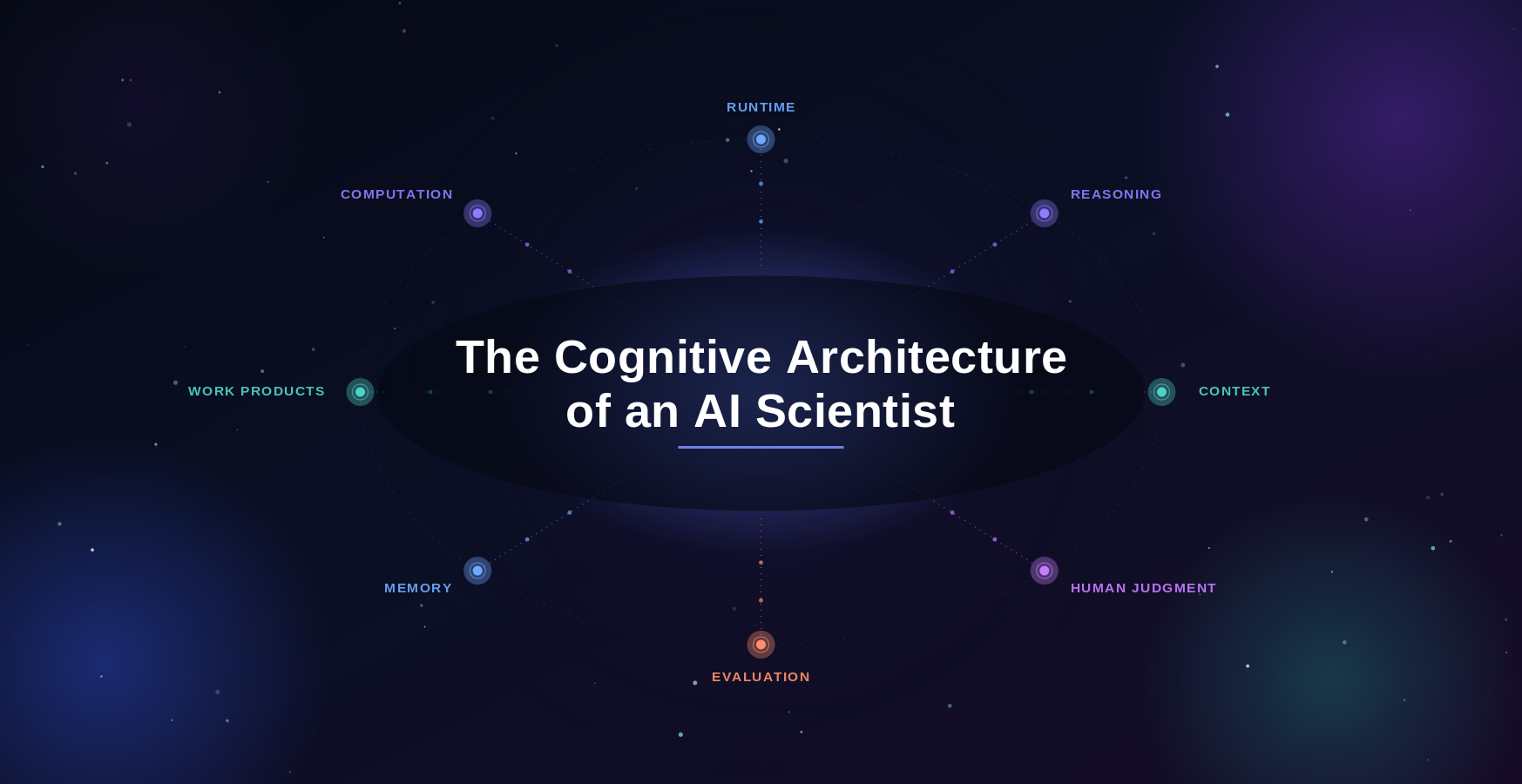
Working backwards from the completed work is an engineering approach to building an AI scientist. Once we define the assignment and the standard it needs to meet, we can determine what the system must be able to do and where it needs human judgment. The scientific harness connects those capabilities to the checks required for that particular piece of work.
R&D and IT executives can assess an agent or vendor by asking it to complete a real assignment under conditions their scientists would accept. The team should specify the expected work product, inspect the result and examine where the agent should have asked for help.
As I discussed in Why Data and LLMs Alone Cannot Create Scientific Outcomes, the value emerges when completed work can enter the organization's scientific decision process.
When an agent can complete assignments to an agreed scientific standard, teams have more capacity to examine additional candidates, test alternative explanations, and resolve evidence gaps before committing to the next study. That is the ambition behind expanding the scientific work an R&D organization can complete, with scientists retaining responsibility for what the evidence justifies doing next.
Further reading



Get started with Causaly
Ready to transform the way your R&D teams discover and deliver? Take the first step - see Causaly for yourself.
Request a demo