How automating scientific workflows improves reproducibility in life sciences
The reproducibility problem in life sciences R&D is structural. It persists because the processes scientists operate within do not constrain the decisions that create variability.
.png)
The reproducibility crisis in life sciences is typically framed as a quality problem: better protocols, more rigorous validation, stricter peer review. These are necessary. They are not sufficient. The challenge is that most research processes are designed to produce one result, not to produce the same result reliably across scientists, projects, and time. Reproducibility requires a different kind of process design entirely and that design begins with workflow automation.
Automated scientific workflows improve reproducibility in three ways: they define the research question at the task level so every scientist retrieves against the same scope; they pass evidence between steps explicitly rather than relying on individual interpretation; and they produce a structured, auditable record of every decision. Together, these properties make consistent outputs a function of the system, not the scientist.
Why does reproducibility fail in manual research workflows?
The reproducibility problem in life sciences R&D is structural. It persists because the processes scientists operate within do not constrain the decisions that create variability.
These structural conditions produce inconsistency in manual research workflows.
1. The research question is defined at the project level but executed at the individual level. Two scientists interpreting the same objective will retrieve against different scopes (different databases, different date ranges, different inclusion criteria) without either being wrong. The system allowed divergence before a single result was produced.
2. Evidence passes between steps informally. Notes, summaries, verbal briefings: each handoff introduces a layer of interpretation. By the time evidence reaches step four of a five-step process, it carries the reasoning of three different scientists layered on top of the original source. The chain of custody is broken.
3. Outputs are formatted for reading, not for the next step. The next scientist must reconstruct the reasoning before they can continue. That reconstruction is itself a source of variability and it takes time that no one accounts for in project plans.
None of these failures is as a result of carelessness. They are built into how the work is structured. That is what makes them persistent and what makes behavioral interventions — work more carefully, document more thoroughly — insufficient.
How does workflow automation address the reproducibility problem?
Each of the these structural failure modes has a direct structural remedy.
Task-level question definition replaces project-level ambiguity: In an automated workflow, each step specifies the exact question it is answering and the evidence scope it retrieves against. Two runs of the same workflow ask the same question in the same way, regardless of who is running them. The scope is a property of the workflow, not of the scientist's interpretation of the brief.
Explicit dependency structure replaces informal handoffs: Evidence passes between steps as structured output, not summary, not notes, not a verbal briefing. There is no interpretation at the point of transfer because there is nothing to interpret: the output of step two is the defined input of step three. This is the mechanism that eliminates accumulated drift across a multi-step process.
Auditable output format replaces outputs designed only for reading: The workflow produces a record of what was asked, what was retrieved, and how it informed the next step. A different scientist (or the same scientist six months later) can open that record, understand the reasoning without reconstruction, and continue from a known position. The knowledge does not reset between runs.
According to ZS Associates (2026) 41% of R&D leaders are planning to automate entire discovery workflows, not individual tasks, but the full chain. The investment reflects a recognition that reproducibility and efficiency are not separate goals; they are both downstream of the same structural discipline.
What does a practical automated reproducible research workflow look like?
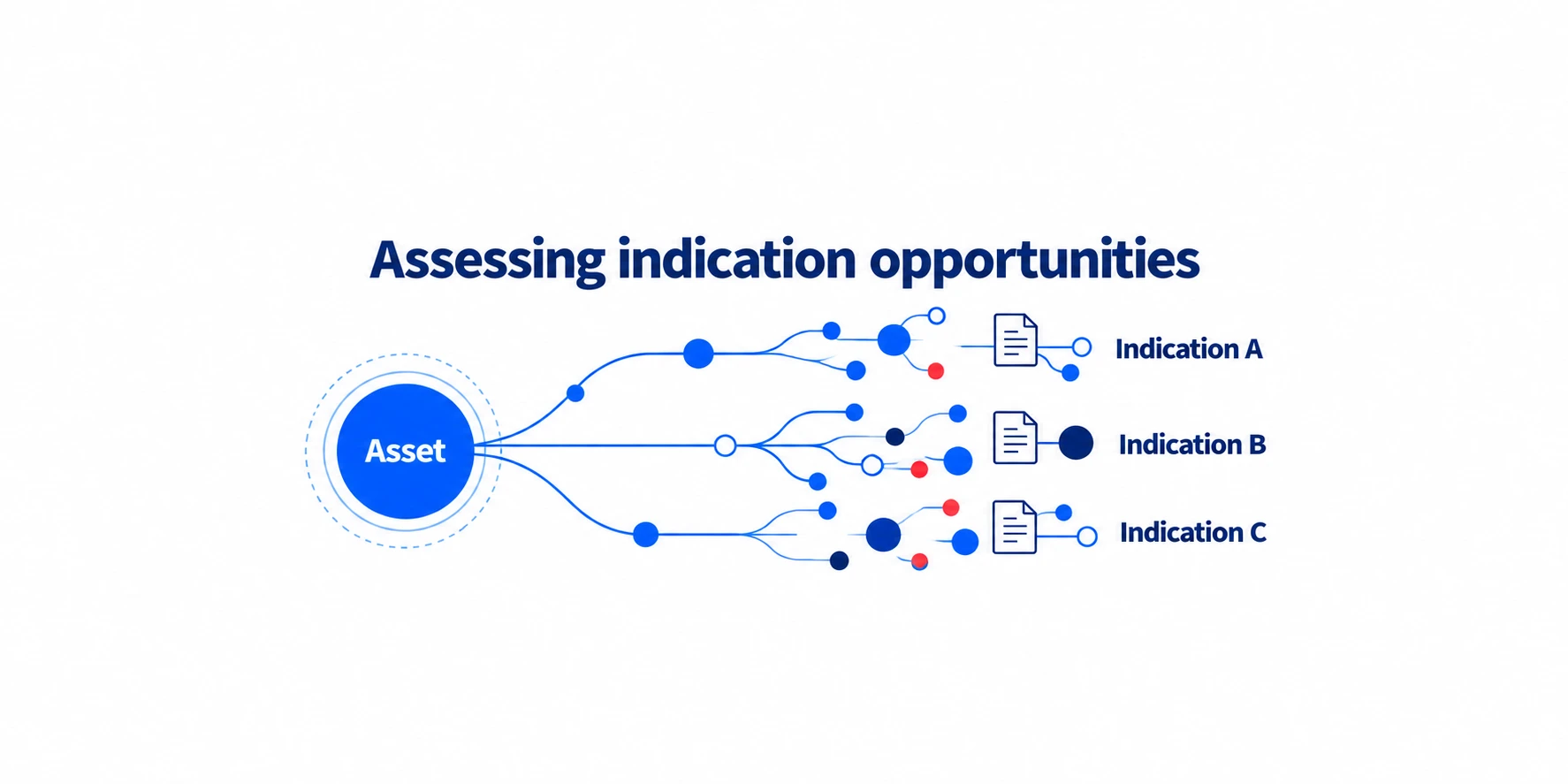
Consider a target biology workflow. The objective: map how a candidate target functions across immune pathways, cell types, and disease mechanisms, specifically the mechanistic understanding that sits between initial target identification and a decision to invest resources in development.
In a manual process, this question is answered differently by every scientist who attempts it. One researcher starts with expression data. Another starts with pathway literature. A third focuses on known safety signals. Each produces a coherent account of the target biology, but the accounts are not directly comparable, because no one defined what the question required before the work began.
In an automated workflow, the question is defined before retrieval starts. The scope is set: which tissue types are relevant to the disease, which pathway relationships count as evidence, which safety dimensions must be addressed for the output to be usable by the next step. Every run of the workflow asks the same question in the same way.
Run this workflow on the same target six months apart, by two different scientists. The biology will have moved, with new papers, new mechanistic data, and updated expression evidence. But the structure of the output will be consistent: the same dimensions covered, the same evidence categories addressed, the same format delivered to whoever makes the investment decision. The scientific content evolves as the field does. The process does not drift.
That is the reproducibility that automated workflows deliver. Not identical conclusions; those should change as the evidence changes. Consistent structure, consistent scope, consistent traceability. The variability that remains is scientific judgment. The variability that has been removed is procedural noise.
.png)
How do you measure whether a scientific workflow is reproducible?
Reproducibility is not a binary property. It is worth measuring along these practical dimensions.
Output consistency. Do two runs of the same workflow by different scientists produce structurally comparable outputs? This does not mean identical conclusions as the evidence may have changed, and scientific judgment is expected to vary. It means comparable evidence scope, comparable output structure, and comparable traceability.
Evidence traceability. Can a reviewer reconstruct exactly what each step retrieved and why? If the answer requires interviewing the scientist who ran the workflow, traceability has failed. The record should be self-contained: question, scope, retrieval, output, next step.
Knowledge accumulation. Does a second run of the workflow start from a more informed position than the first? In a well-designed automated workflow, the output of each run becomes an input to the next, that is a structured addition to a growing evidence base rather than a document filed and forgotten. This is the measure that most clearly distinguishes automation from digitization: the system learns the shape of the problem over time.
Designing toward these metrics requires deliberate architectural decisions, about how questions are specified, how outputs are structured, and how the record is maintained. That design work is real, and it is not trivial. But it is tractable. And it is the work that makes reproducibility a durable property of the research process rather than a goal that resets with every new project.
The question that follows is architectural: what does a system need to look like to support this kind of workflow at scale?
See it in practice. If you want to see how Causaly's handle evidence retrieval, task dependencies, and structured outputs across a real research process, book a demo and we'll walk you through it.
Further reading

.png)

.png)
.png)


Get started with Causaly
Ready to transform the way your R&D teams discover and deliver? Take the first step - see Causaly for yourself.
Request a demo