What Makes a Scientific Workflow Auditable?
Auditability starts with preserving the scientific context of an analysis as it runs.
A scientist reviews an AI-generated target assessment and disagrees with the conclusion. The report looks rigorous. Every major claim has a citation, the sources are credible, and the analysis follows a clear structure. But the scientist cannot see why the workflow reached its conclusion.
Which evidence was considered before the target was scored? Were contradictory findings included? Why did one study carry more weight than another? Which criteria were applied? Where was the evidence weak or incomplete? And where did a scientist intervene?
The citations provide the sources behind individual claims, while the reasoning and decisions that shaped the overall assessment remain unclear. As AI takes on more of the research process, a scientific workflow can break a question into multiple tasks, search publications, trials and internal knowledge, assess evidence against defined criteria and use the results of one step to determine what happens next.
A target assessment, for example, might examine disease association, genetic evidence, pathway biology, pharmacological validation, safety and clinical precedent. Evidence gathered in each area contributes to the final assessment, but the final report may compress that work into a score, several paragraphs and a reference list. A scientist reviewing the result needs to understand how the evidence led to the conclusion.
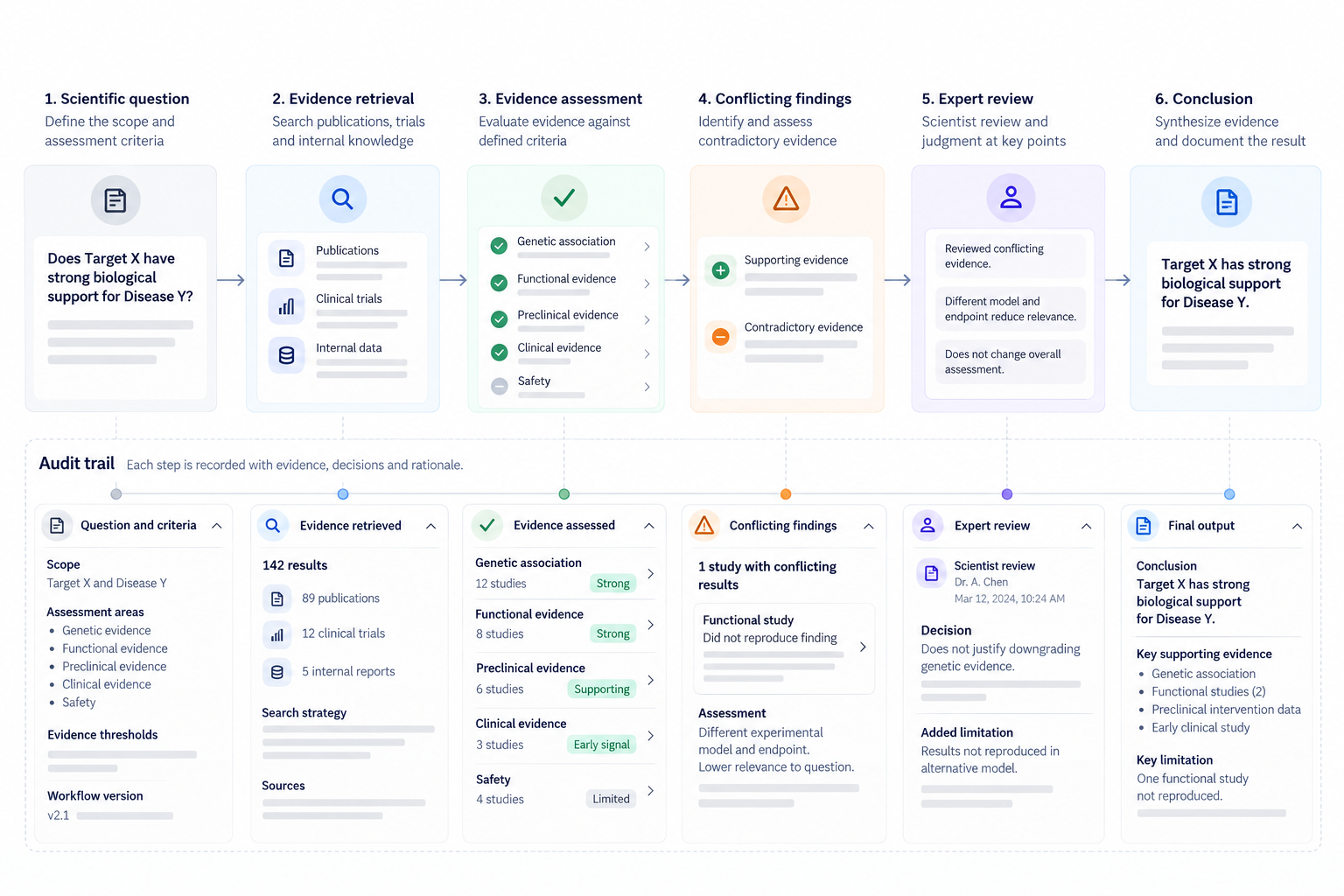
Consider a workflow that concludes that Target X has strong biological support for Disease Y. The audit trail should show the scientific path behind that conclusion.
It should show that the workflow found strong genetic association between Target X and Disease Y, identified two functional studies supporting the proposed mechanism, found supporting preclinical intervention data and located an early clinical study.
It should also record a functional study that failed to reproduce one of the findings and how that evidence was assessed. Perhaps the study used a different experimental model and endpoint, which affected its relevance to the question while keeping the finding within the evidence base.
If a scientist reviews the conflicting evidence and decides that it does not justify downgrading the genetic evidence, that intervention should also be recorded, along with the limitation added to the final assessment. The resulting record connects each stage of the analysis:
Scientific question → evidence retrieved → evidence assessed → conflicting findings considered → expert review → conclusion
Another scientist can then identify the part of the assessment they want to examine. They may agree with the genetic evidence while questioning how the functional studies were weighted. They may challenge the relevance of the clinical evidence or identify an important study that was missed.
Without this record, reviewing the conclusion can require repeating much of the research simply to understand how the original assessment was made.
What makes a scientific workflow auditable?
An auditable scientific workflow preserves the scientific context of an analysis as it runs. That includes:
- A defined scientific method. The workflow specifies the steps, evidence requirements, assessment criteria and expected outputs before execution.
- Evidence provenance. Findings remain connected to their underlying sources and scientific context throughout the workflow.
- Intermediate decisions. The record shows how evidence was assessed, why certain paths progressed or stopped, and how those decisions shaped subsequent steps.
- Uncertainty and conflicting evidence. Limitations, evidence gaps and contradictory findings remain visible through synthesis.
- Expert judgment. Checkpoints record where scientists reviewed the evidence, what they decided and how their input affected the workflow.
- Workflow versioning and controls. Completed analyses remain linked to the methodology, criteria, data sources and permissions in place when they were produced.
The scientific method behind a workflow also needs to reflect how the organization works. R&D teams develop their own processes for assessing evidence, applying scientific criteria, involving experts and deciding when an analysis is ready to progress. Those methods often sit across SOPs, templates and individual expertise, which can lead to variation between teams and projects.
Causaly Scientific Workflows codifies these organizational processes into repeatable workflows, so the organization’s scientific standards, evidence requirements and review points are applied as the work is executed. The audit trail then shows how a specific assessment followed that process, including the evidence used, decisions made and expert input along the way.
Evidence needs scientific provenance
A citation establishes the source behind a statement. Scientific review often requires the context surrounding that evidence.
If a safety workflow identifies a cardiovascular liability, the reviewer may need to know whether the evidence came from an animal model, observational data or a clinical trial, alongside the population, dose, endpoint and experimental context.
Causaly Scientific Workflows carries evidence and its provenance through research, analysis and synthesis, allowing scientists to trace a finding back to its underlying source and understand how it informed the assessment.
Intermediate decisions need to remain visible
Decisions made at one stage can determine what gets investigated at the next.
An indication exploration workflow might identify ten biologically plausible indications, then progress four after evaluating target-disease evidence. The remaining six may have weak genetic support, conflicting disease biology or evidence that fails a predefined threshold.
Retaining those intermediate results shows why each indication progressed or stopped and gives reviewers access to the evidence and criteria behind the decision.
Uncertainty needs to survive synthesis
Scientific evidence is often mixed. Genetic support may be strong while pharmacological validation is limited, studies may conflict, or clinical evidence may still be absent.
Those differences can disappear when several stages of analysis are compressed into a final narrative.
Causaly Scientific Workflows can retain conflicting findings, limitations and evidence gaps alongside supporting evidence, allowing reviewers to see where support is strong, limited or unresolved.
Expert judgment should be recorded where it happens
Some decisions require scientific judgment, such as determining whether a safety signal is biologically meaningful or whether conflicting studies can be reconciled based on experimental design.
Causaly Scientific Workflows can include checkpoints and stop gates where experts review the available evidence. The record captures the decision and how it affected subsequent steps, preserving expert input within the history of the analysis.
The workflow itself needs a version history
Research methods evolve as teams update evidence criteria, data sources, scoring frameworks and assessment methods.
Completed analyses should remain linked to the workflow version that produced them, including the methodology, criteria and available sources. Relevant controls should also be recorded, including which sources and tools the workflow could access and where approval was required.
This preserves the methodological context of previous analyses as the workflow evolves.
Building the audit trail into scientific execution
A scientific audit trail connects the method, evidence, intermediate decisions, uncertainty, expert input and final conclusion.
Causaly Scientific Workflows builds these elements into repeatable scientific processes. Evidence remains connected to its provenance, intermediate outputs can be inspected, expert review occurs at defined points, and completed analyses remain associated with the workflow that produced them.
For a scientist reviewing a target assessment, indication strategy, safety signal or competitive landscape, this provides a clear route through the analysis. They can see which evidence informed each stage, how it was assessed, where uncertainty remained and how expert decisions affected the outcome.
The final output carries the scientific record behind the conclusion, giving teams a clear basis for reviewing, challenging and defending the assessment.
Further reading
.png)
.png)
.png)


Get started with Causaly
Ready to transform the way your R&D teams discover and deliver? Take the first step - see Causaly for yourself.
Request a demo