Indication Expansion at Takeda: From 65 Candidates to 10 in One Month
Indication Expansion at Takeda: From 65 Candidates to 10 in One Month
Challenges
R&D leadership at Takeda needed an evidence-backed shortlist of candidate indications for an existing asset within six weeks. The team had a point of comparison. A similar exercise run through an external vendor in 2021 had taken more than six months and produced a list of over 65 candidate indications with no clear, defensible path to narrowing it further.
Indication expansion decisions carry weight beyond the analysis itself. An asset already in the clinic has a lower barrier to starting a new program than a novel target does, which means the evidence bar for choosing the right indication has to be higher, not lower. The team typically handled one or two indication expansion assessments a year, a pace set less by scientific interest than by the effort required to trace an asset’s biology across a sufficient evidence base before committing a program to a direction.
How Causaly Helped

Assessing the biology behind candidate indications
The team used Causaly to assess the target’s underlying biology and identify associated indications, including candidates the earlier vendor project had not surfaced. The resulting list was reprioritized against the latest published evidence, then layered with competitive and market context to complete the picture.
Evaluating mechanistic and translational evidence
What the team looked for went beyond a simple co-occurrence of the asset, its mechanism, and a candidate indication in the literature. Co-occurrence alone is not sufficient evidence to act on. The team needed the semantics behind each relationship, specifically whether the association was causal, because a defensible indication expansion case has to rest on a credible mechanistic and translational basis for changing disease biology in the proposed patient population, not on the frequency with which a target and a disease appear together in the published record.


From more than 65 indications to 10 in one month
The list narrowed from more than 65 indications to 10 within one month, ahead of the six-week mandate. The resulting hypotheses showed high concordance with Takeda’s internal computational models, giving the team an independent check on the shortlist before it moved forward into translational planning.
The headline number, a 5 to 20x increase in addressable patient population from the same asset, sits alongside a second result that changed the team’s operating capacity going forward. The time and cost of running this kind of assessment fell by an estimated 20-fold, moving indication expansion at Takeda from a one-or-two-asset-a-year exercise to one the team can now run against as many as ten assets in the same period.
Keeping every hypothesis traceable to its evidence
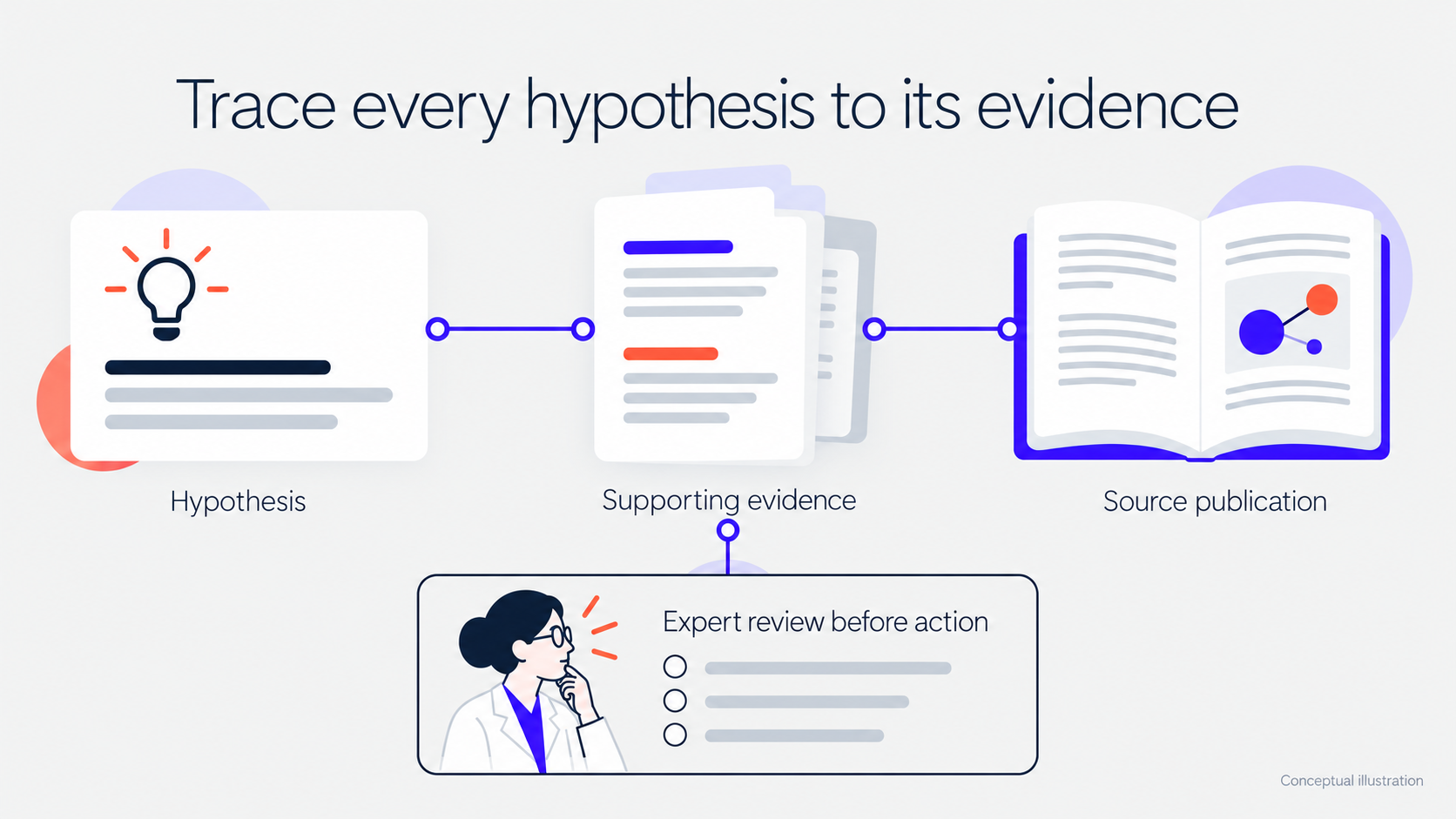
What made the shortlist defensible was that every hypothesis on it could be traced back to the specific evidence behind it, all reviewed by agents and sourced only from peer-reviewed publications, evaluated against the same standard the team would have applied to a manual review, just compressed into a fraction of the time.
Before committing to a translational study or a clinical program on the strength of any one indication, the team validates the underlying evidence directly and traces it back to source. AI supports and synthesizes the evidence. It does not make the call. That distinction, Arunachalam notes, is what let the team trust a result generated in a month enough to act on it.


The search churned through almost 20,000 articles. We didn't just want a co-occurrence of our asset, our mechanism, and the indication. We wanted to understand if it's causal. That's what a specialized platform helped us narrow down, not just reaching through all 20,000 articles, but extracting the context and the causal relationship. That's what was critical.



Get started with Causaly
Ready to transform the way your R&D teams discover and deliver? Take the first step - see Causaly for yourself.
Request a demo